Road construction performance is not determined only by the asphalt or concrete surface. In many projects, the long-term behaviour of a road depends heavily on what happens below the pavement layer. Weak subgrades, poor drainage, unsuitable aggregate, heavy traffic loading and poor installation practices can all contribute to rutting, settlement, cracking and premature maintenance.
This is why geosynthetic materials are increasingly considered in modern road construction. When properly selected and installed, geosynthetics can help improve the performance of granular layers, support better load distribution and reduce deformation in suitable ground conditions.
However, geosynthetics should not be treated as a universal shortcut. Their performance depends on soil conditions, aggregate quality, layer thickness, drainage, loading and installation. A well-designed road system considers all of these factors together.
Why Subgrade Stability Matters in Road Construction
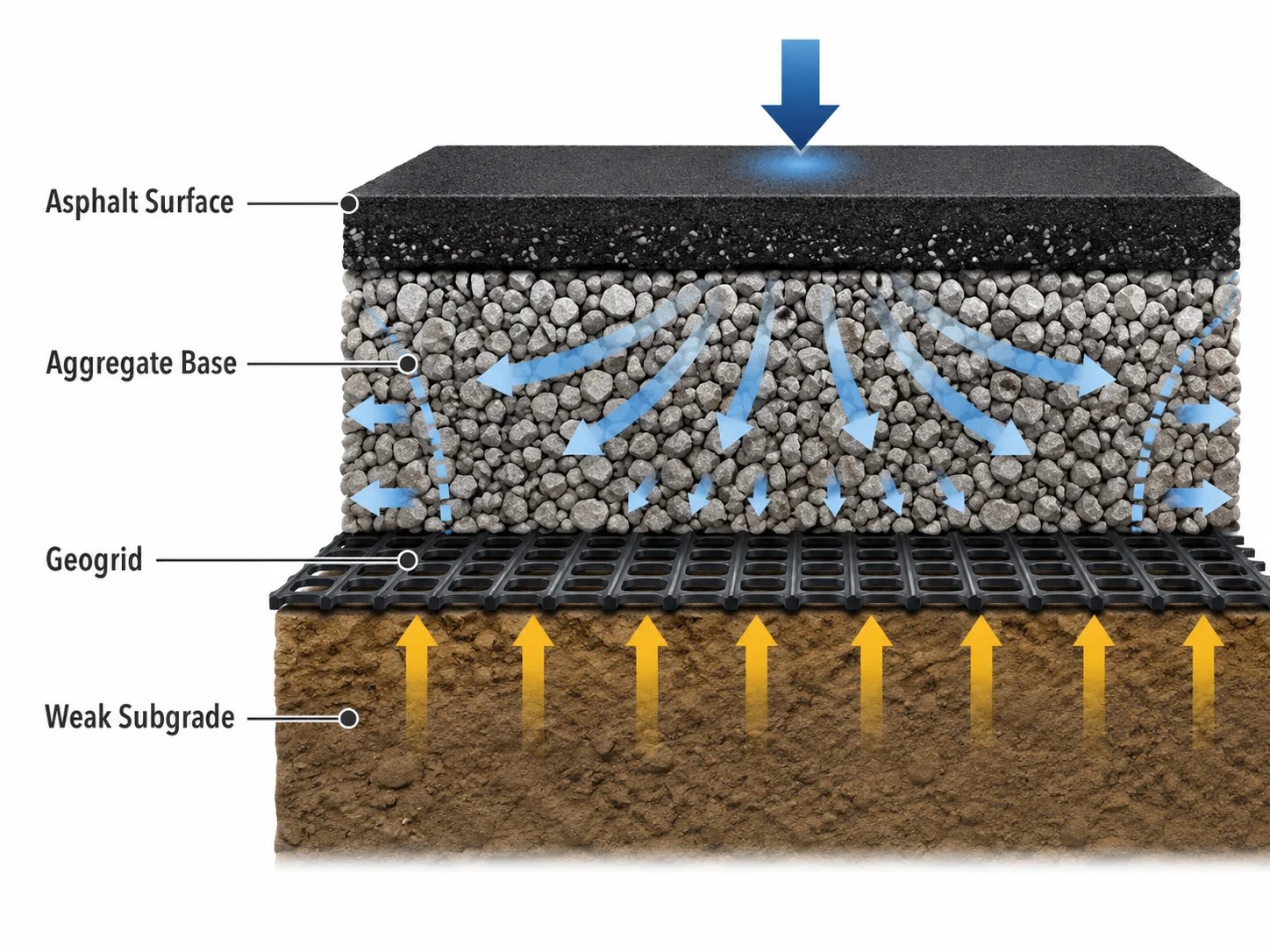
The subgrade is the natural soil or prepared ground that supports the road structure. If the subgrade is firm, well-drained and properly compacted, it can provide a stable foundation for the pavement system. If it is weak, variable or moisture-sensitive, the road may experience deformation even when the upper layers are built with good materials.
Common subgrade-related problems include:
- rutting under repeated wheel loads
- pumping or migration of fine soil particles
- settlement in soft or poorly compacted ground
- loss of aggregate support during wet seasons
- reduced pavement life due to uneven load transfer
These issues are especially common in temporary access roads, rural roads, industrial yards, haul roads and construction platforms where soil conditions may change across the site.
In such cases, the goal is not simply to “add a product” to the road structure. The goal is to improve the way the road base, aggregate and subgrade work together.
How Geosynthetics Support Road Base Performance
Geosynthetics are a broad category of polymeric materials used in contact with soil, rock or other civil engineering materials. In road construction, different geosynthetics may be used for separation, filtration, drainage, reinforcement or stabilization.
For road base applications, geogrids are commonly considered when the project requires improved aggregate confinement and better load distribution over weak or variable ground. A geogrid has an open grid-like structure that can interact with compacted aggregate. When the aggregate particles partially interlock with the grid apertures, lateral movement of the aggregate layer may be reduced.
This interaction can help the granular layer behave more effectively as part of a road system. In suitable conditions, it may reduce rutting, improve service performance or help the road achieve a required performance level with a more efficient aggregate section.
The Federal Highway Administration has also published guidance and resources on geosynthetics in transportation and geotechnical applications, including their use in roads, walls, slopes, drainage and erosion control systems.
The Role of Geogrid in Weak Road Subgrades
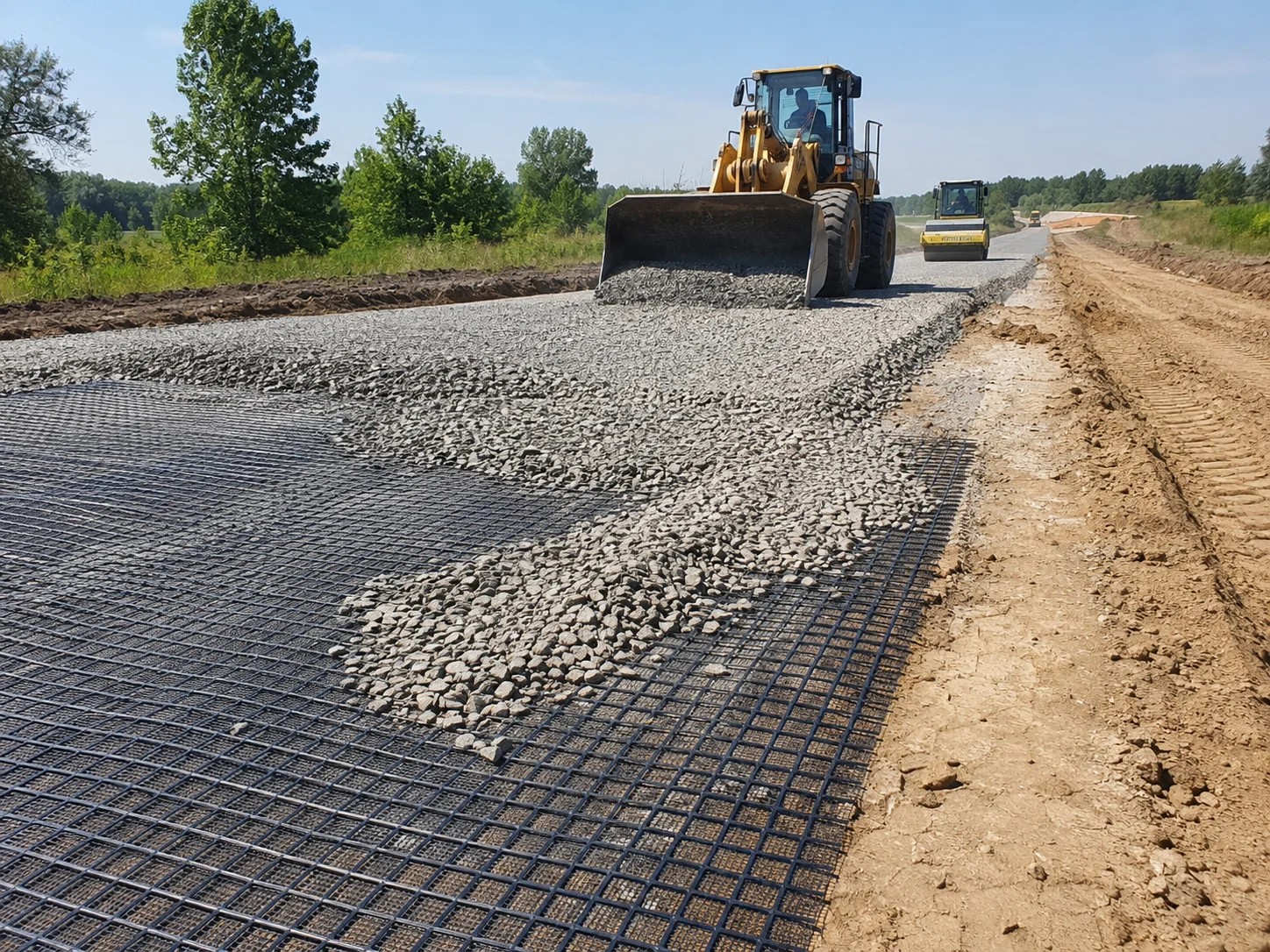
Geogrid is often used where the subgrade has limited bearing capacity or where the road must carry repeated traffic over soft, wet or variable soil. In these situations, the geogrid does not work alone. It works together with the aggregate layer and the supporting ground.
For projects involving weak or moisture-sensitive soils, geogrid reinforcement for weak road subgrades can help improve aggregate confinement and support better load distribution. However, final performance still depends on subgrade strength, aggregate quality, drainage, traffic loading and installation quality.
A common misunderstanding is that a higher tensile strength automatically means better road performance. In reality, road stabilization is a system behaviour. Tensile strength is only one product property. Low-strain response, aperture geometry, aggregate interaction, junction behaviour, installation damage resistance and project-specific conditions may also influence performance.
This is why road geosynthetic selection should consider both product data and project conditions.
Key Factors That Affect Geosynthetic Road Performance
1. Subgrade condition
Subgrade strength is one of the first factors to evaluate. Very soft or saturated soils may require additional measures such as drainage improvement, stabilization, staged construction or increased aggregate thickness.
A fixed soil value alone should not be used to select a geogrid or determine the complete road section. Field conditions, soil variability and moisture changes should also be considered.
2. Aggregate quality and gradation
The aggregate layer plays a major role in geogrid performance. Angular, well-graded aggregate usually interacts better with geogrid openings than rounded or poorly graded material. If the aggregate is too fine, too rounded or poorly compacted, the expected interlock may be reduced.
3. Base or subbase thickness
Layer thickness affects how loads are distributed through the road structure. A geosynthetic may improve performance, but it does not eliminate the need for a properly designed aggregate layer.
Any potential reduction in aggregate thickness should be supported by a recognized design method, performance testing or project-specific engineering review.
4. Drainage
Water is one of the most important factors in road performance. Poor drainage can weaken the subgrade, reduce aggregate support and increase deformation under traffic.
Geogrid does not replace drainage. If water is allowed to accumulate within the road structure, even a reinforced section may not perform as expected.
5. Traffic loading
A temporary access road used by light vehicles is very different from a haul road used by heavy trucks or construction equipment. Repeated axle loads, turning movements and construction traffic can all affect long-term performance.
6. Installation quality
Installation is often as important as material selection. Wrinkles, insufficient overlap, poor aggregate placement, direct traffic on exposed geogrid or inadequate compaction can reduce performance.
The geosynthetic should be placed, covered and compacted according to the approved construction procedure before heavy trafficking.
Can Geosynthetics Reduce Aggregate Use?
In some road applications, geosynthetics may help reduce the amount of aggregate required to achieve a specified performance target. This is one reason they are often considered in road base stabilization and temporary access road construction.
However, aggregate reduction should not be treated as a fixed percentage. It depends on the subgrade, traffic, aggregate properties, design method, required service life and the geosynthetic product used.
For example, a design method or full-scale test may support aggregate reduction under certain tested conditions. But that result should not be automatically applied to a different soil type, different aggregate, different loading condition or different road structure.
A more accurate way to describe the benefit is this: geosynthetics may improve the efficiency of the aggregate layer when the system is properly designed and installed.
Common Mistakes in Road Geosynthetic Applications
Choosing by tensile strength only
Ultimate tensile strength is useful for product comparison and quality control, but it does not fully describe road performance. Road stabilization also depends on aggregate interaction, low-strain behaviour, installation and system performance.
Ignoring drainage
A reinforced road section can still fail if water is trapped in the pavement structure. Drainage should be considered early, especially in wet climates or moisture-sensitive soils.
Using unsuitable aggregate
Poor aggregate quality can reduce interlock and overall performance. Aggregate gradation, angularity and compaction should be compatible with the selected geosynthetic.
Allowing traffic on exposed geogrid
Construction traffic should not normally run directly on exposed geogrid unless the approved procedure allows it. Adequate cover material is usually required before trafficking.
Assuming one product fits all projects
There is no single geogrid specification suitable for every road, platform or subgrade. The correct selection depends on the project function and design conditions.
Conclusion
Geosynthetics can play an important role in modern road construction, especially where weak subgrades, variable soil conditions or aggregate efficiency are key concerns. By improving aggregate confinement and supporting better load distribution, geogrids may help improve road base performance in suitable conditions.
But geosynthetics should always be considered as part of a complete road system. Subgrade strength, aggregate quality, layer thickness, drainage, traffic loading and installation quality all influence the final result.
For road designers, contractors and project owners, the best approach is to evaluate geosynthetics not as a standalone product, but as one component within a properly designed and installed pavement structure.