
If you manufacture bespoke construction products, your team probably types the same order several times: into an email reply, a quote spreadsheet, a CAD drawing and your ERP. Every retype takes time and gives your teams another chance to get a number wrong.
Take a bespoke glass balustrade. A contractor emails a sketch of a first-floor balcony with measurements, and your salesperson prices it in a spreadsheet. The contractor then asks for wider post spacing and a brushed stainless steel handrail, so the price is worked out again. Once the order is signed, an engineer redraws the balustrade in CAD and someone keys it into the ERP. Somewhere along the way, a 1,200 mm panel becomes 1,020 mm.
A 3D product configurator lets you enter that order once. Your customer or salesperson designs the balustrade on screen, each choice is checked against your product rules, and the confirmed design automatically generates the drawings and part lists production needs. Below, we cover what re-keying costs, how a 3D configurator changes the order process and how to choose one.
What does re-keying bespoke orders cost a manufacturer?
Retyping costs time on every quote and creates errors that surface in production. You won’t see it as a line on your P&L, which makes it easy to accept as part of doing business. The wider numbers suggest it isn’t small. A McKinsey analysis found that construction productivity grew by just 10% between 2000 and 2022, against 50% for the economy as a whole.
In research involving more than 600 companies selling custom products, around one in four respondents identified slow quoting or manual processes as a pain point, and 29% of construction companies reported order errors caused by misunderstood specifications.
For construction product manufacturers, manual order entry tends to show up in four places:
- Slower quotes. When every enquiry needs someone to interpret a sketch, check which components work together and build a spreadsheet, a competitor that quotes faster may win the order.
- Errors that reach production. A dimension copied wrongly, a missing fixing or a glass panel paired with an incompatible post can mean rework and a delayed installation.
- Time lost to admin. Sales and office staff spend hours copying measurements from emails into spreadsheets and then into the ERP, when they could be following up enquiries and looking after customers.
- Reliance on a few experienced people. If only two people know how to price a complicated balustrade system, quoting stops when they are off. New hires also take longer to learn rules that live mostly in colleagues’ heads.
Hiring more staff adds capacity, but it doesn’t fix a process that needs the same information interpreted and entered several times.
How does a 3D product configurator change the order process?
A 3D product configurator is software that guides your customer, distributor or sales rep through product’s options step by step, updating a 3D model and the price with each choice in real time. Your product rules run in the background, so every combination it offers fits together and can actually be manufactured.
For a construction product manufacturer, those rules carry most of the value. They decide which dimensions are allowed and which components work together, so nobody can order a glass type that doesn’t support the chosen balustrade height. The price is worked out as the design changes, because visual CPQ (configure, price, quote) is built into the configurator instead of being handled later in a spreadsheet.
Once the design is confirmed, a configurator connected to your ERP, CRM, or PIM can generate:
- the bill of materials and cutting lists
- CAD drawings for approval and for production
- CNC-ready files for cutting and machining
- a PDF quote or spec sheet, with visuals, dimensions and price, for the customer
- the order file, with prices, sent straight to the ERP
Production then works from the same design the customer approved on screen.
So the same tool serves several stakeholders: Your sales team can quote with it, and distributors and installers can order through it. Put it on your website and contractors can configure and price a product themselves.
What does the same order look like with and without a configurator?
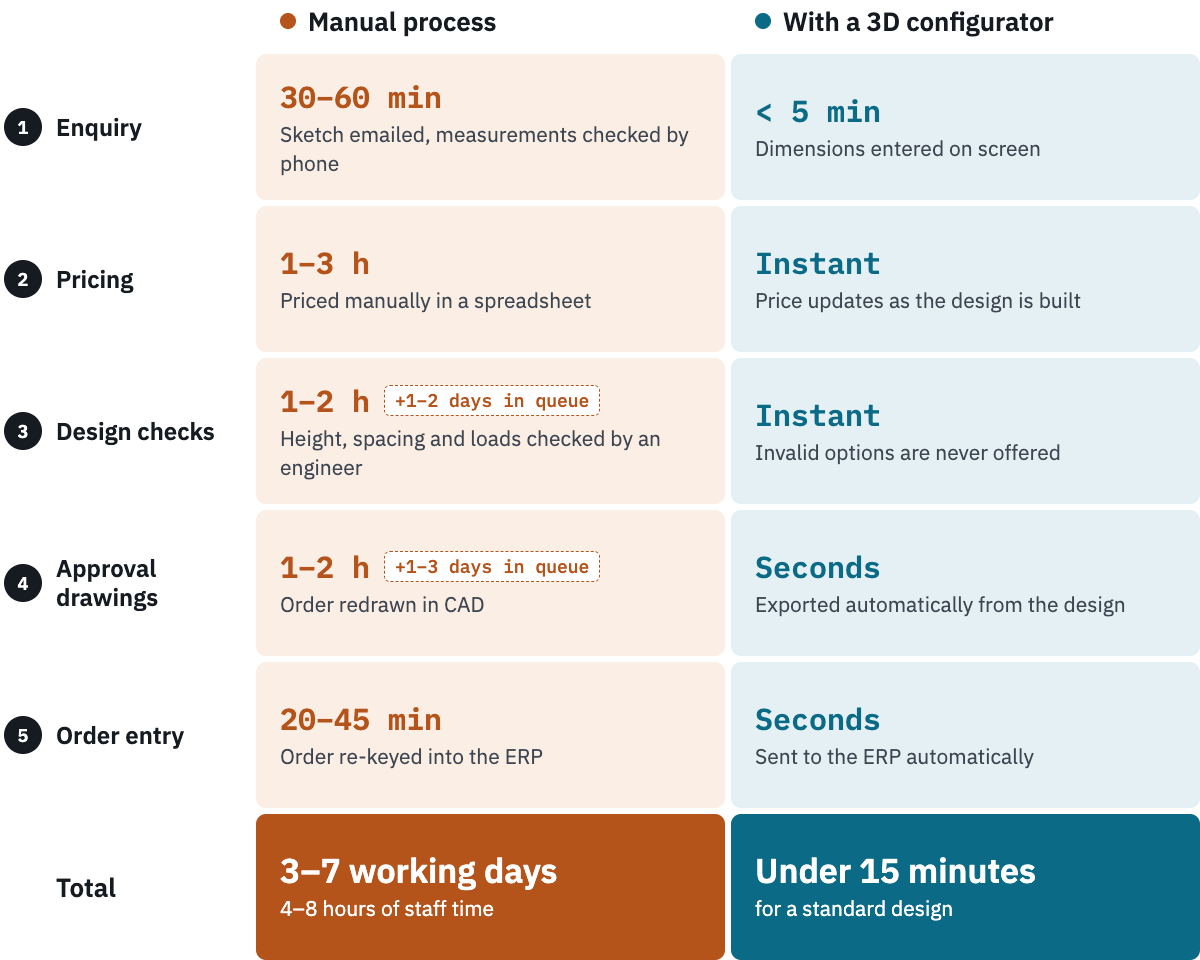
Say a contractor needs a glass balustrade for a first-floor balcony: a 4.2 m run along the front, a 900 mm return at one end and 12 mm glass. The table follows that order through each stage, first manually and then with a 3D configurator.
Manual process vs configurator, stage by stage:
How to Choose the Right 3D Product Configurator for Construction Products
Manufacturers have always had two routes: buy a configurator or build one. Building used to need a fully dedicated development team that only large companies could afford. But with AI tools getting better by the day, almost anyone can now build a working 3D configurator demo in an afternoon, and for a simple product that may be enough.
In construction, though, every error can cost a lot. An AI-built configurator handles the 3D well but often gets the product rules wrong, and nothing on screen shows the mistake until it reaches production. If your products are complex and come in thousands of combinations, it is safer to work with a vendor that already builds 3D configurators for construction products, like Salsita.
What you should ask a configurator vendor:
- Does it handle real engineering logic? Parametric models should recalculate geometry and check structural limits whenever a dimension changes.
- Can users configure a whole system? A balcony is glass, posts, handrail and fixings. Users should be able to build all of it in one scene and adjust each part on its own.
- Does it serve every type of buyer? Direct customers, distributors, installers and your own sales team each need their own pricing, permissions and workflow.
- Will it connect to your existing systems? Ask which ERP, PIM, CRM and e-commerce platforms it integrates with, and who maintains those connections.
- What does the workshop get? You want CAD models, bills of materials, CNC data and cutting lists, not just a good-looking render and a price.
That’s where AI-built prototypes and dedicated platforms part ways. A quick AI prototype earns its place when you want to test an idea or get your management team on board. But once your configurator has to prove code compliance and produce submittal-ready drawings, it runs out of road fast.
Wrapping Up: Enter Each Bespoke Order Once
Every time your team re-keys a bespoke order, it costs hours and adds another chance for a mistake. Capture the order once with a 3D configurator, with your product rules built in, and it can move from enquiry to workshop in minutes rather than days.
Most construction product manufacturers still quote by email and spreadsheet, which leaves the door open for whoever moves first. Your buyers, meanwhile, have already changed how they buy. In a Gartner survey published in March 2026, 67% of B2B buyers said they prefer to buy without a sales rep, and 45% had used AI during a recent purchase.
The manufacturers that move first will quote faster, make fewer mistakes and become the supplier that contractors find easiest to buy from.
FAQ
What is CPQ software? CPQ stands for configure, price, quote. It lets your sales team or customers design a product within your rules and calculates the price and quote automatically.
Will a 3D product configurator replace my sales team? No. It takes the routine quotes off their desk so they can spend their time on complex projects and on keeping your product rules up to date.
Can a 3D product configurator connect to my ERP? Many can send the finished order, including prices and part lists, straight to your ERP and CRM. Ask any supplier which software they connect to before you commit.
How long does implementation usually take? It varies with product complexity, but most manufacturers start with a single, well-understood product line rather than their entire catalogue, which keeps the initial rollout to a matter of weeks rather than a company-wide project. Ask for a realistic timeline based on your specific product range.





