
Two buildings go up in the same year, to the same architect’s detail. Both have brushed stainless cladding at ground level and stainless balustrades on the upper terraces. One stands in a city centre. The other is a few hundred metres from the seafront. Three years later, the city building still looks crisp. The coastal one carries a brown, rust-coloured film the trade calls tea staining, and it is worst on the sheltered panels under the terraces, where rain never reaches.
Nobody used the wrong material. Both buildings used stainless steel. They simply used the same stainless steel in two very different places.
That is the point most specifications miss. “Stainless” is not one material but a family of alloys, and the gap between the cheapest and the most resistant member of that family is wider than most schedules allow for. This guide is written from the supply side: which grades suit which parts of a building, how to let the site make the decision, and what to put on the order so that the steel delivered matches the steel on the drawings.
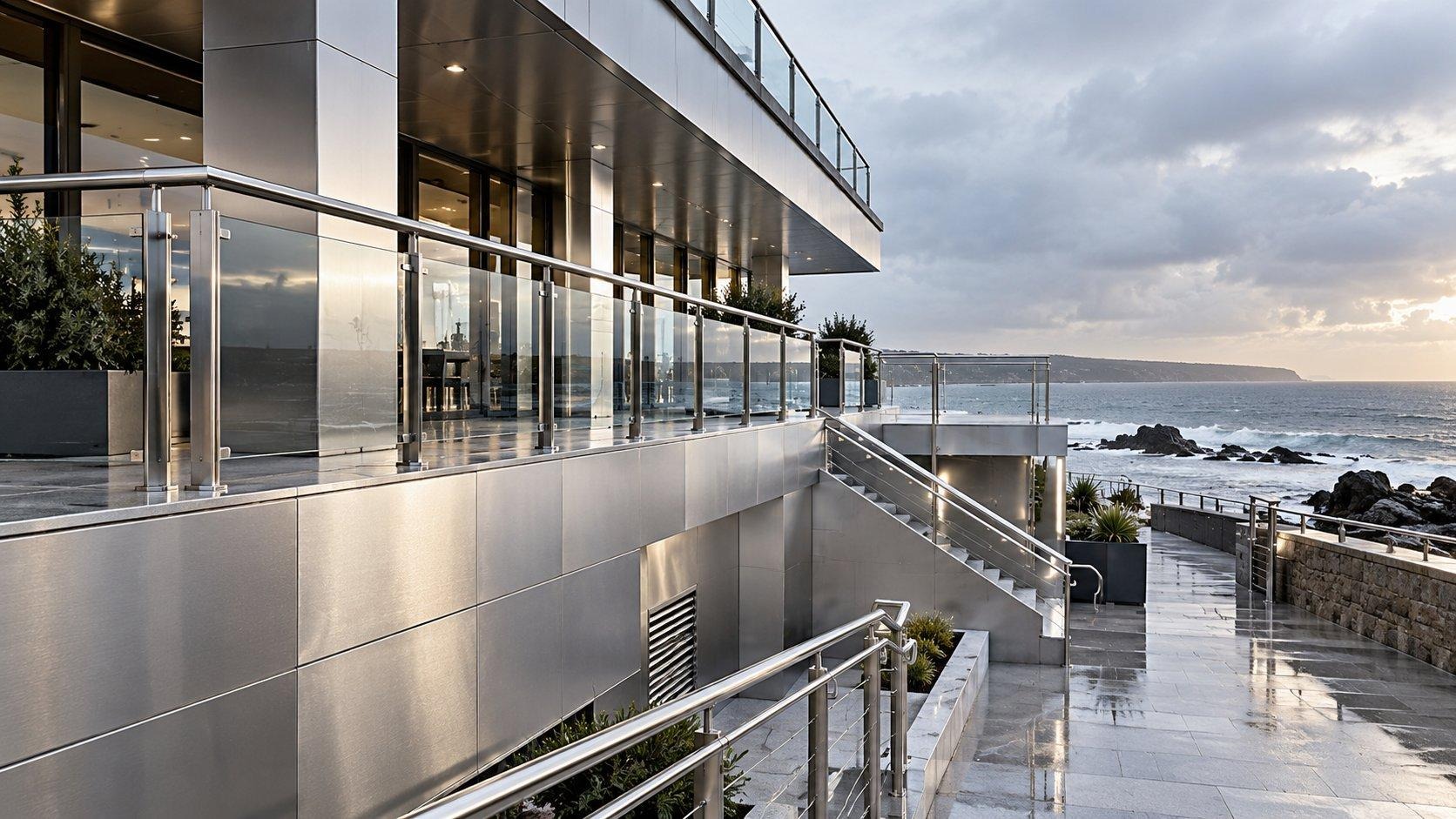
Same detail, different environment: sheltered coastal surfaces that rain cannot wash are the first to stain.
Four ways a stainless specification goes wrong
Most stainless problems on buildings trace back to one of four decisions:
- One grade for everything. The grade that is perfect for an internal handrail can struggle on a coastal façade, inside a kitchen extract duct or above a swimming pool.
- Value engineering by grade. Swapping 316 for 304, or 304 for a lower-cost grade, looks like a saving on paper.
- Ignoring the location. Distance from the sea, de-icing salt on the road outside, urban pollution and chlorinated air all change what a grade has to cope with.
- Forgetting about rain. Surfaces that rain washes clean usually perform well. Soffits, canopy undersides and recessed panels collect salt and dirt that never get rinsed off, so they stain first.
The value-engineering point deserves a closer look. Moving up a grade adds to the material cost, but once fabrication, access and labour are included, material is usually a modest share of the installed price. Cleaning a stained façade, replacing corroded fixings or re-cladding a sheltered elevation means paying for that access and labour a second time. On an exposed site, the higher grade is very often the cheaper choice over the life of the building. The 304 versus 316 decision is the one that comes up on almost every project, and it is worth settling before the tender goes out rather than at the first cost review.
The grades a building actually uses
| Grade (EN number) | Type | Key property | Typical building use |
|---|---|---|---|
| 430 (1.4016) | Ferritic, about 16% chromium, no nickel | Lower, more stable cost; magnetic | Dry internal panels, trims and casings |
| 201 (1.4372) | Austenitic, manganese replacing part of the nickel | Lower cost, good strength | Dry internal decorative items only |
| 304 / 304L (1.4301 / 1.4307) | Austenitic, about 18% chromium and 8% nickel | Good all-round corrosion resistance | Internal handrails, lift interiors, washrooms, kitchens, sheltered inland exteriors |
| 316 / 316L (1.4401 / 1.4404) | Austenitic with about 2% molybdenum | Much better resistance to chlorides | Coastal and urban façades, external balustrades, drainage, wet kitchen zones, exposed fixings |
| Duplex 2205 (1.4462) | Austenitic-ferritic | About twice the strength of 304; very good chloride resistance | Structural members, heavily loaded fixings, marine sites |
| High-alloy austenitics (e.g. 1.4529, 1.4547) | High molybdenum and nickel | Highest resistance to chloride attack and stress corrosion cracking | Load-bearing parts in swimming pools and other severe environments |
The “L” versions have lower carbon, which reduces the risk of corrosion along welds. For welded fabrications such as balustrades, frames, canopies and drainage channels, 304L or 316L is usually the safer choice, and most mills now certify material to both the standard and the L grade at once.
Let the site choose the grade
In the UK, structural stainless design follows BS EN 1993-1-4 (Eurocode 3, Part 1-4), and its Annex A gives a method that many specifiers now use for non-structural elements too. It scores three factors: chloride exposure from the sea or road salt; sulphur dioxide from industrial and heavy urban pollution; and the cleaning regime, meaning whether the surface is rain-washed or regularly cleaned. The total points to a corrosion resistance class (CRC), from CRC I (mild) to CRC V (severe), and each class lists its suitable grades. As a rough guide, 430 sits in CRC I, 304 in CRC II and 316 in CRC III. Duplex 2205 sits in CRC IV and the high-alloy grades in CRC V. The International Molybdenum Association publishes a similar free site-evaluation system for architectural stainless that walks through the same questions.
The method turns a vague question (“is 304 good enough?”) into a scored decision that can be written into the specification. It also explains why the same balustrade detail can need different grades on two different sites.
Grade by building element
The table below is a starting point. The final choice should follow the environment assessment and, for structural elements, the engineer’s design.
| Building element | Starting grade | What to watch |
|---|---|---|
| Façade cladding, rainscreen, roofing and flashings | 304 inland; 316 in coastal, polluted or road-salt areas | Sheltered areas and soffits are higher risk; specify a smooth finish |
| External balustrades and handrails | 316L; duplex for long spans or high loads | Fixings and base plates must match the balustrade grade |
| Internal handrails, lift interiors, door furniture | 304 | Finish and grain direction matter more than grade here |
| Masonry wall ties and brick support angles | Austenitic stainless (304 or 316) to BS EN 845-1 | 316 in coastal and aggressive locations |
| Anchors, bolts and fixings | A2 (304) internally and on mild sites; A4 (316) on coastal and exposed sites | Grades to BS EN ISO 3506; never mix with zinc-plated fixings |
| Water supply pipework | 304L or 316L tube to BS EN 10312 | Fittings must be suitable for drinking water |
| Commercial kitchens, washrooms, drainage channels and gullies | 304 in dry and splash areas; 316L in wet and chlorinated zones | Standing water, salt and chlorinated cleaners are a demanding mix (see below) |
| Load-bearing parts in swimming pool halls | High-alloy grades (CRC V) | See the special case below |
Where it goes wrong: a contractor fits 316L balustrades on a seafront apartment block, but the base plates are bolted down with standard zinc-plated anchors. Within a year, rust bleeds from every fixing point and the balustrades get the blame. The weakest part of a stainless assembly is usually the part nobody specified.
The aggressive environment hiding inside the building: commercial kitchens
Not every harsh environment is outdoors. A commercial kitchen combines heat, steam, salt, acidic food residues and chlorine-based sanitisers, then pressure-washes the lot into the drains every night. For metal, it is one of the most demanding rooms in a building, and it is usually specified last, after the services have already been fixed.
Three material decisions matter, and all three need to be made while the plumbing, electrical and ventilation routes are still being locked down, before the cabinets, worktops and canopies are ordered:
- Hygiene surfaces. 304 in a 2B or fine-brushed finish covers worktops, splashbacks, shelving and canopy skins. Food-contact surfaces should be smooth (a roughness of Ra 0.8 µm or better is the usual hygiene benchmark) with welded, coved corners rather than open seams where residue collects. Behind pot-wash and dishwasher stations, where hot water carries chlorinated detergent and sometimes brine, step up to 316L stainless steel sheet for the splashback and the sink surround.
- Ventilation ducting. Grease, condensation and cleaning chemicals all meet inside the extract duct. 430 is sometimes offered to trim the budget; it belongs in dry, decorative positions, not inside a kitchen extract run. Specify 304 as the minimum, and 316L for extract from dish-wash areas or for intake ductwork on coastal sites. Sealed seams and cleaning-access panels should be on the drawing, not improvised on site.
- Drainage. Channels, gullies and grease-trap connections sit in standing water loaded with salt, fat and bleach. 316L is the safe starting point; 304 is acceptable only for fittings that drain fully and stay dry between services.
Where it goes wrong: a 430 splashback is fitted behind a pot-wash sink because it matched the budget. Chlorinated detergent splashes dry on it every night. Within months it is pitted, and the client is asking why the “stainless” has rusted.
Getting these three right is less about exotic grades and more about matching 304 and 316L to the wet and dry zones of the room. Suppliers who work regularly on stainless for kitchen workspaces can usually map that split onto a kitchen layout in a single conversation.
The special case: swimming pools
Pool hall air is warm, humid and full of chlorine compounds. It condenses on ceiling hangers, fixings and support steel, and it is never rinsed off. Under these conditions, ordinary grades such as 304 and even 316 can suffer stress corrosion cracking, which can progress with very little visible warning.
The risk is well documented. In 1985, the ceiling of a swimming pool in Uster, Switzerland, collapsed and twelve people died; its stainless steel hangers had failed through stress corrosion cracking. The Health and Safety Executive’s guidance on stainless steel in swimming pool buildings still asks operators to inventory every stainless component in a pool hall by grade, location and function. BS EN 1993-1-4 treats load-bearing parts in pool atmospheres as a special case and, for parts that are not regularly cleaned, points to the highest-resistance grades. On pool projects, show every load-bearing stainless component above the water on the drawings with its grade stated. Don’t leave it to the installer.
What to tell your supplier
Many problems that surface on site start with an order that left too much to interpretation. From the mill and stockholder side, these are the details that make the biggest difference:
- Use the standard finish codes. “Brushed” can mean very different surfaces. BS EN 10088-2 gives each finish a code: 2B is smooth cold-rolled, 2R is bright annealed and 2J is brushed. 2K is a smooth brushed finish for external and coastal architecture, with a transverse roughness (Ra) below 0.5 µm. For a coastal façade, writing “2K” is clearer than any description.
- State the grain direction. For external brushed panels, a vertical grain lets rain wash down along it. Adjoining panels should run the same way, or the façade will look patchy.
- Specify the protective film. External panels need a UV-resistant film, and parts going to laser cutting need laser-grade film that will not bubble or burn. Film on external panels should come off soon after installation, before sunlight bakes it on.
- Ask for levelled, cut-to-length sheet for large flat panels. Coil memory shows up as oil-canning on big cladding panels and long worktops. A levelling line takes it out before the sheet is cut.
- Work to standard sheet sizes. Panel modules that nest into common sheet widths, such as 1,000, 1,250 or 1,500 mm, cut offcut waste and cost.
- Allow for dual certification. Material is often certified to both EN and ASTM standards, for example as dual-grade 304/304L or 316/316L. This is normal, and it satisfies both the standard and the low-carbon versions.
- Check lead times early. Common grades and finishes in 304 and 316 are widely stocked. Duplex, high-alloy grades, 2K finishes and heavy plate can take longer, so confirm availability before the programme depends on them.
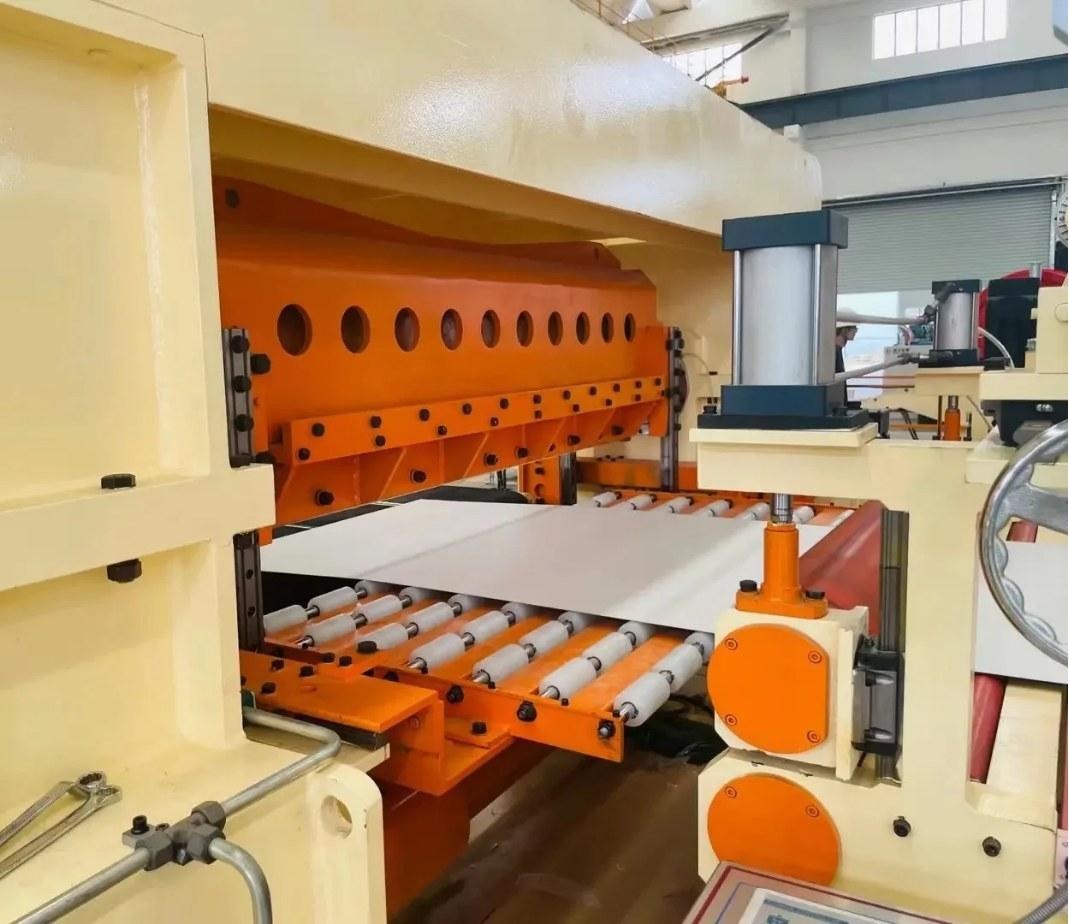
A levelling line flattens sheet straight off the coil before cutting; it is the difference between a flat façade panel and one that oil-cans. Photo: Walmay Stainless.
From mill to site: protecting and proving the steel
Stainless steel resists corrosion through a thin, self-healing chromium oxide layer. Poor handling damages this layer more often than the weather does. Carbon steel contamination is the classic cause of rust spots on stainless that “shouldn’t rust”: grinding sparks, shared tools and steel wire brushes leave iron particles behind, and those particles rust on the surface. Store and work stainless away from carbon steel, use dedicated tools, and pickle and passivate welds. In wet details, isolate stainless from galvanised steel, aluminium and copper.
On site, most grades look the same, so it pays to check the paperwork:
- Ask for an EN 10204 type 3.1 mill test certificate for every batch. It should show the grade, heat number and actual chemical composition.
- Match the heat number on the sheet, tube or protective film to the certificate.
- Check the chemistry. 316 should show around 2% molybdenum or more, and 304 roughly 8% nickel or more. Low nickel with high manganese points to a 200-series grade.
- Don’t trust a magnet. 430 is strongly magnetic, but 304 can also become slightly magnetic after bending or cold working. A handheld XRF (PMI) analyser is the reliable site check.
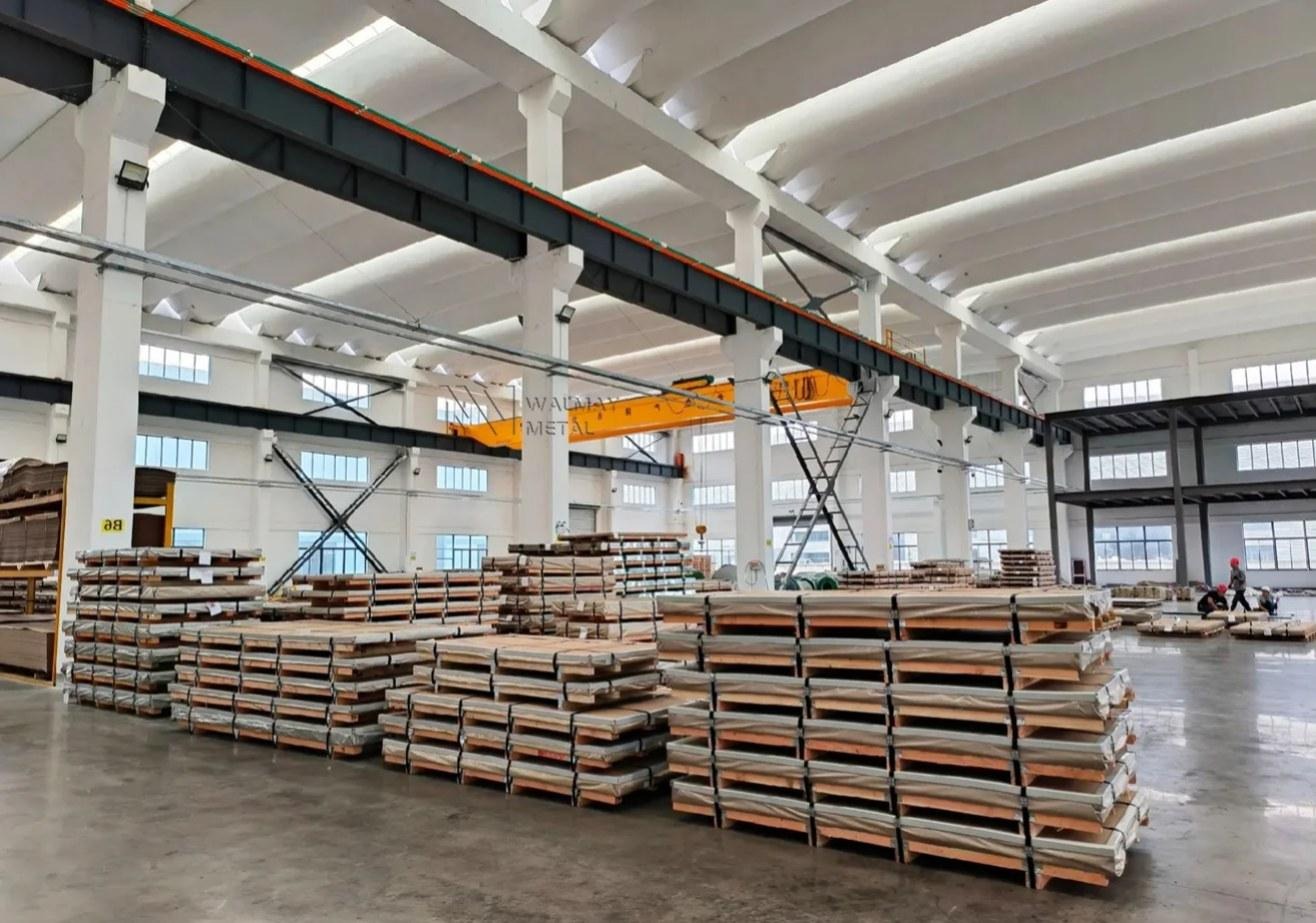
Stainless sheet and plate held in stock, each bundle tagged to its heat number so it can be matched to a 3.1 certificate on site. Photo: Walmay Stainless.
A supplier that ships traceable stainless steel sheet, pipe and coil with a 3.1 certificate for every heat takes most of the guesswork out of this step. If the certificate cannot be produced, treat the material as unknown.
Before you order: a short checklist
- Environment assessed for each location, with the resulting grade recorded
- L grades for welded fabrications
- EN 10088-2 finish code for each visible surface, plus grain direction
- Every fixing, anchor and bracket graded to match the part it holds
- Kitchen wet zones, extract ducts and drainage identified and graded before the fit-out is ordered
- Film type, sheet sizes and lead times agreed with the supplier
- 3.1 certificates for every batch, checked before fabrication starts
- Swimming pool and other severe-environment components identified individually
The right steel in the right place
Specified properly, stainless steel can last the life of a building with very little maintenance. 304 covers most internal work and sheltered inland exteriors. 316 earns its cost near the coast, beside salted roads, in polluted cities and in the wet zones of a commercial kitchen. Duplex and high-alloy grades are there for the loads and environments where the stakes are highest.
Match the grade to the environment. Give the finish and fixings the same attention as the panels. Then put it all clearly on the order. A façade that still looks new in twenty years is not luck. It is a specification decision.
About the author: Rémi writes technical content for Walmay Stainless, a stainless steel manufacturer supplying sheet, pipe, bar and coil in more than 300 grade and size combinations, with mill test certificates, to buyers in over 100 countries.





