You’re standing in your hallway, kids tripping over shoes again, and you think: we need more space. But here’s the question that keeps you up at night, should you go up or go out? It’s not just about square footage. It’s about money, disruption, and whether you’ll actually get back what you spend when you sell. The truth is, both loft conversions and home extensions can transform your house, but one might hand you a much better return on investment than the other.
Key Takeaways
- Loft conversions typically add 15% to 20% in property value with lower costs (£45,000–£50,000), offering stronger percentage ROI than house extensions.
- House extensions can increase value by 20% to 25% but require larger budgets (£40,000–£150,000+) and longer build times of up to six months.
- Choosing between a house extension vs loft conversion depends on your property type, location, and local buyer demand for bedrooms versus open-plan living space.
- Loft conversions are ideal for urban homes with limited outdoor space, whilst extensions suit family suburbs where ground-floor living and kitchen-diners are highly valued.
- Both projects require careful planning to maximise ROI—match your investment to local market trends, use quality finishes, and keep spending below 20% of your home’s current value.
Understanding Property Value: What Does It Really Mean?
Property value isn’t some mysterious formula that only estate agents understand. It’s simply what buyers are willing to pay for your home based on a mix of tangible and emotional factors.
At its core, value reflects market appeal. A three-bedroom semi in Manchester will fetch more than a two-bedroom one, all else being equal. Extra bedrooms, additional living space, and modern layouts rank high on buyer wish lists. But it’s not just about adding rooms, it’s about adding the right rooms in the right way.
Local demand plays a huge role. In urban areas where space is tight and families compete for school catchments, an extra bedroom can spark bidding wars. In suburban areas with generous plots, buyers might value a sprawling kitchen-diner that opens onto the garden more than another upstairs bedroom.
When you’re weighing up a loft conversion or house extension, you’re really asking: which improvement will make more buyers want my home, and how much extra will they pay? The answer depends on your property type, location, and what’s missing from your current layout.
What Is a Loft Conversion?
A loft conversion transforms that dusty, cobweb-filled attic into a proper living space, usually a bedroom, home office, or even a snug en-suite master retreat. You’re working within your home’s existing footprint, which means no digging up the garden or losing precious outdoor space.
The beauty of a loft conversion lies in its efficiency. You’re using space that’s already there, just sitting idle. Most UK homes have lofts with enough headroom (you’ll need at least 2.2 metres) to make this work. The process involves reinforcing floor joists, adding insulation, installing windows (like Velux rooflights), and fitting a staircase.
It’s a relatively quick job, too. Many loft conversions wrap up in four to five weeks, depending on complexity. You won’t lose a chunk of garden, and because you’re building within your roof space, there’s often less disruption to your daily routine compared to major building works.
Types of Loft Conversions
Not all loft conversions are created equal, choosing a trusted company such as CNR Construction is essential to avoid pitfalls with projects. The type you choose affects cost, space gained, and how much value you’ll add.
Velux (Rooflight) Conversion: The simplest and cheapest option, costing between £25,000 and £35,000. You’re adding windows into the existing roof slope without changing the roofline. Best for lofts that already have decent headroom. You get natural light and usable space, but it’s the most limited in terms of floor area.
Dormer Conversion: This involves extending the roof outwards to create more headroom and floor space. Expect to pay £40,000 to £55,000. Dormers come in flat-roof or pitched styles and significantly increase the usable area. They’re popular because they offer good value for the extra space you gain.
Hip-to-Gable Conversion: If you have a hipped roof (where the roof slopes on all sides), you can convert one side to a gable end (vertical wall). This opens up much more space, particularly at the sides. Costs run from £45,000 to £60,000. It’s a smart choice for semi-detached or detached homes.
Mansard Conversion: The premium option, costing £55,000 to £70,000 or more. A mansard involves altering the roof structure to create a flat roof with a steep rear slope, maximising headroom and floor area. You’ll often see these in Victorian terraces in London. They offer the most space but usually require planning permission.
What Is a House Extension?
A house extension means building outwards or upwards (or both) to create entirely new space beyond your home’s current walls. Think of it as adding a whole new room, or several, to your property.
Extensions typically fall into two categories. A single-storey extension might be a new kitchen-diner, a garden room, or an extended living area. These cost around £1,800 to £2,500 per square metre. A double-storey extension stacks two floors, often adding a large kitchen downstairs and an extra bedroom above, costing £2,200 to £2,800 per square metre.
Overall, you’re looking at a budget of £40,000 to £150,000 or more, depending on size and spec. That’s a significant investment, but the payoff can be substantial if you’re creating the kind of open-plan, family-friendly space that today’s buyers crave.
Extensions involve groundworks, foundations, brickwork, roofing, and full internal fit-out. Build times vary, expect anywhere from eight weeks for a modest single-storey to six months for a large double-storey project. The process is more disruptive than a loft conversion. You’ll have builders on site longer, materials delivered, and your garden torn up during construction.
But here’s the upside: you gain flexible, ground-floor space. Extensions let you reimagine how your home flows. You can knock through walls, flood the space with light via bi-fold doors, and create that kitchen-living-dining hub that’s become the heart of modern family life.
Value Comparison: The Data on ROI
So, which one actually adds more value? Let’s talk numbers.
Loft conversions typically deliver a 15% to 20% increase in property value. If your home is worth £300,000, a loft conversion might add £45,000 to £60,000. Given that the average loft conversion costs around £45,000 to £50,000, your return on investment is strong. You’re often recouping most or even all of your spend, and sometimes making a profit.
House extensions, on the other hand, can add 20% to 25% to your property’s value. On that same £300,000 home, you could see a £60,000 to £75,000 uplift. But remember, extensions cost more, often £40,000 at the low end and up to £150,000 for large, high-spec projects. Your absolute gain may be higher, but your percentage ROI can be lower, especially if you overspend on luxe finishes that buyers don’t value.
Here’s the key insight: loft conversions offer better percentage ROI because they’re cheaper and faster. Extensions can deliver more absolute value in pounds, particularly when you’re adding substantial ground-floor space that transforms how a family uses the home.
But ROI isn’t the only measure. Value also depends on buyer demand. In urban markets with tight housing stock, an extra bedroom from a loft conversion can be gold. In family suburbs where gardens and entertaining space matter, a big kitchen extension might win every time.
The smartest move? Match your project to what buyers in your area actually want. Check recent sales on Rightmove or Zoopla. Are four-bedroom homes selling faster than three-bedroom ones? Do properties with open-plan living command a premium? Let the data guide your decision.
Cost Analysis: Loft Conversion vs House Extension

Money matters. Let’s break down the real costs so you can budget properly.
Loft conversions average between £45,000 and £50,000 for a standard dormer conversion. Velux conversions start around £25,000, whilst mansard conversions can exceed £70,000. On a per-square-metre basis, you’re paying roughly £1,150 to £1,350. That’s relatively affordable compared to extensions because you’re not building from scratch, you’re adapting existing space.
Hidden costs can creep in, though. If your roof structure needs significant reinforcement, or if access is tricky (narrow staircases, awkward layouts), expect extras. Factor in around 10% to 15% contingency for surprises.
House extensions have a wider cost range. A modest single-storey side return might start at £40,000, but a large, architect-designed double-storey rear extension with underfloor heating, bi-fold doors, and premium finishes can easily hit £150,000 or more.
Per square metre, single-storey extensions cost £1,800 to £2,500, while double-storey extensions run £2,200 to £2,800. Double-storey builds cost more per square metre than singles because of the added structural complexity, but they often give you better overall value since you’re spreading foundation costs across two floors.
Extensions also come with extra expenses: planning permission fees (typically £206 for householder applications), architect fees (10% to 15% of build cost), structural engineer reports, and potential party wall agreements if you’re semi-detached or terraced.
Bottom line: loft conversions are cheaper and offer tighter cost control. Extensions offer more flexibility but require a bigger upfront investment and carry more financial risk if your project runs over budget or timescale.
Pros and Cons of Loft Conversions

Advantages of Loft Conversions
Loft conversions tick a lot of boxes if you’re after quick wins and lower costs.
Cost-effective: At £45,000 to £50,000 on average, they’re significantly cheaper than most extensions. You get strong ROI because you’re spending less upfront.
Less disruptive: Most projects finish in four to five weeks. Builders work upstairs, so your kitchen and main living areas stay functional. No scaffolding blocking your garden, no foundations being dug.
Permitted development: Many loft conversions fall under permitted development rights, meaning you won’t need planning permission. That saves time, money, and hassle. You’ll still need to comply with building regulations, but the approval process is simpler.
Adds bedrooms fast: An extra bedroom is a proven value-booster, especially in urban areas. Lofts are perfect for creating a master suite, guest room, or teen hideaway.
Retains garden space: You’re not sacrificing outdoor space, which matters if your garden is already small or if you love your outdoor area.
Disadvantages of Loft Conversions
But lofts aren’t perfect. They come with limitations.
Limited space: You’re constrained by your existing roof structure. If your loft has low headroom or awkward angles, you might not gain as much usable floor area as you’d hoped.
Suitability checks needed: Not every property is suitable. Older homes with complex roof trusses, or properties with insufficient headroom, may require expensive structural work or may not be viable at all.
Less flexible for ground-floor use: If what you really need is a bigger kitchen or living room, a loft conversion won’t solve that problem. You’re adding space upstairs, not where family life happens on the ground floor.
Staircase placement: Fitting a new staircase can eat into existing bedroom space. You need to plan carefully to avoid making another room awkwardly small.
Potential resale perception: Some buyers view loft rooms as ‘bonus’ space rather than proper bedrooms, particularly if ceiling height is marginal or if the room feels cramped.
Pros and Cons of House Extensions
Advantages of House Extensions
Extensions offer flexibility and the chance to completely reimagine your home.
Greater space and flexibility: Extensions let you create exactly what you need, a vast kitchen-diner, a home office, a utility room, a playroom. You’re not limited by your roof structure.
Ground-floor living: Modern families spend most of their time on the ground floor. Extensions put the extra space where you’ll actually use it daily.
Higher absolute value for families: A well-executed extension can add 20% to 25% to your home’s value, particularly if you’re creating open-plan living that buyers love. In family-oriented markets, this can translate to tens of thousands of pounds.
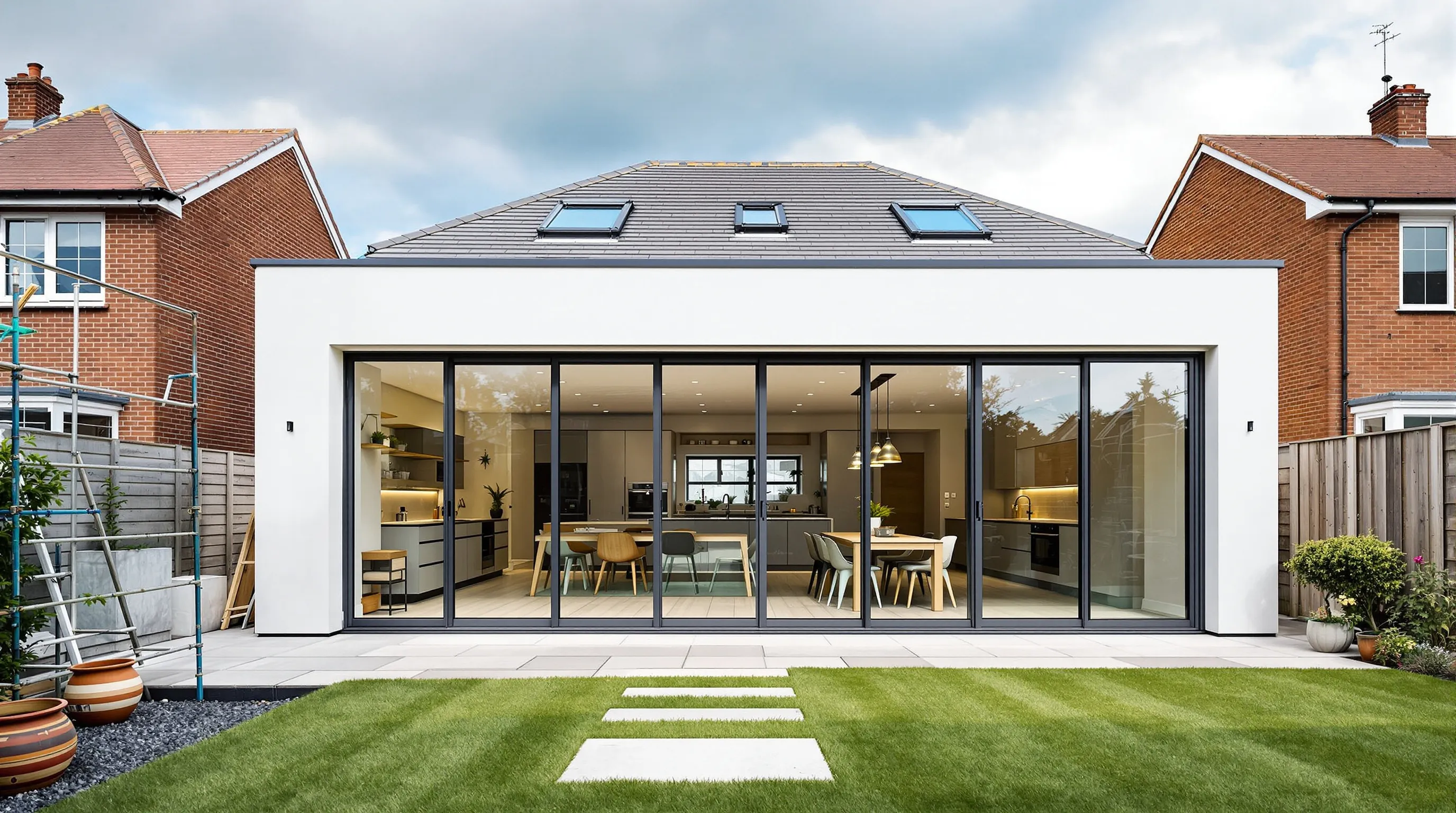
Architectural impact: Extensions give you the chance to make a design statement. Think vaulted ceilings, skylights, and walls of glass that bring the garden indoors.
Increases kerb appeal: A sympathetically designed extension can improve your home’s exterior appearance, especially if you’re replacing an old conservatory or tired lean-to.
Disadvantages of House Extensions
Extensions also come with downsides you need to weigh carefully.
Costlier: At £40,000 to £150,000+, extensions demand a serious financial commitment. Overspend, and you risk not recouping your investment.
Disruptive: Expect months of building work, noise, dust, and limited access to parts of your home. If you have young kids or work from home, this can be stressful.
Longer build time: Extensions take longer to complete, anywhere from two months to six months or more. Weather delays, material shortages, and unforeseen issues can push timelines out further.
Often needs planning permission: Unlike many loft conversions, extensions frequently require planning permission, especially if you’re building beyond permitted development limits. That adds time, cost, and uncertainty. There’s always a risk your application could be refused.
Loss of garden space: If you have a small garden, a large extension can make outdoor space feel cramped or even unusable. For families who love their garden, that’s a real trade-off.
Planning Permission and Building Regulations
Let’s clear up the red tape.
Loft conversions often benefit from permitted development rights, which means you can proceed without planning permission, as long as you stay within limits. Your conversion must not exceed the highest part of the existing roof, and the volume allowance is 40 cubic metres for terraced houses and 50 cubic metres for detached and semi-detached homes.
But even if you don’t need planning permission, you’ll always need to comply with building regulations. These cover structural integrity, fire safety (escape routes, fire doors), insulation, and staircase design. Your builder or architect will handle this, but it’s your responsibility to ensure sign-off happens.
House extensions usually require planning permission if they extend beyond permitted development limits. Single-storey rear extensions can go up to 6 metres (8 metres for detached homes) under permitted development, but side and front extensions have stricter rules. Double-storey extensions almost always need planning permission.
Planning applications cost £206 for householder applications in England and take eight weeks on average to process. If your plans are complex or if neighbours object, it can take longer.
Building regulations apply to extensions too, covering foundations, damp-proofing, insulation, drainage, and electrical work.
Party wall agreements are another consideration if you share a wall with a neighbour (terraced or semi-detached homes). You’ll need to serve notice and potentially agree on a party wall award, which protects both parties. Budget around £700 to £1,500 for party wall surveyor fees.
Bottom line: loft conversions usually involve less planning hassle, which is one reason they’re quicker and cheaper. Extensions require more upfront legwork, but the payoff is greater design freedom.
Key Factors That Influence Which Option Adds More Value
Choosing between a loft conversion and an extension isn’t a one-size-fits-all decision. Several factors will shape which option adds more value to your home.
Property Type and Location
Your property type and location matter enormously.
Loft conversions suit urban and suburban homes where space is tight and land is expensive. If you’re in a terraced house in London, Bristol, or Manchester, going up makes more sense than going out. Lofts are also ideal if your garden is small and you can’t afford to lose outdoor space.
They work well for Victorian and Edwardian homes with generous roof heights. Modern new-builds with low-pitched roofs and trussed rafters are often less suitable, or require costly structural changes.
House extensions thrive in family suburbs where gardens are larger and buyers prioritise ground-floor living. If you’re in a semi-detached or detached home with a decent plot, an extension lets you create the kind of open-plan kitchen-diner-living space that families dream about.
Extensions also make sense if your area has strong demand for family homes and if comparable properties nearby have already been extended. Check local sold prices: are extended homes commanding a clear premium?
Available Space and Home Layout
Look at what you’ve got to work with.
If your loft has good headroom (at least 2.2 metres from floor to ridge) and a simple roof structure, conversion is straightforward. But if your roof is cluttered with water tanks, complex trusses, or minimal height, you’ll face higher costs and potentially limited usable space.
For extensions, assess your garden and plot. Do you have room to extend rearwards or sideways without making your garden feel cramped? Is there enough space for access during the build? Can you maintain a reasonable outdoor area post-extension?
Consider your current layout too. If you already have enough bedrooms but your kitchen is tiny and dark, an extension makes more sense. If your ground floor is spacious but you’re bursting at the seams upstairs, a loft conversion is the logical fix.
Buyer Preferences and Market Trends
Understand what buyers in your area want.
In tight urban markets, bedroom count is king. An extra bedroom can shift your property from a two-bed that appeals to couples into a three-bed that attracts young families. That’s often a significant jump in value. Loft conversions are perfect for this.
In family-focused suburbs, open-plan living is the big draw. Buyers want space to cook, eat, and relax together. A rear extension that creates a large kitchen-diner with bi-fold doors opening onto the garden is highly desirable. That can justify a premium price.
Check local estate agent listings and recent sales. Talk to a few agents about what’s selling and what buyers are asking for. If every home on your street has four bedrooms and yours has three, a loft conversion could be your ticket. If every home has a modest kitchen and yours could be transformed with an extension, that’s your answer.
Don’t just follow your personal taste. Think like a buyer, because they’re the ones who’ll eventually decide what your home is worth.
Tips to Maximise Value from Your Project
Whichever route you choose, here’s how to squeeze every penny of value from your project.
Add an en-suite if possible: En-suite bathrooms significantly increase desirability, particularly for master bedrooms. If your loft conversion or extension can accommodate an en-suite, it’s often worth the extra spend.
Use quality finishes: Don’t skimp on fixtures, flooring, or joinery. Buyers notice shoddy workmanship and cheap finishes. Aim for mid-range or better, think brushed nickel taps, engineered wood floors, and well-fitted units.
Maximise natural light: Light sells homes. Velux windows, bi-fold doors, skylights, and large glazed panels make spaces feel bigger and more appealing. Don’t create dark, cramped rooms.
Match local demand: We’ve said it before, but it’s worth repeating. Align your project with what buyers in your area actually want. Don’t build a five-bedroom home in a two-bedroom area, and don’t create a bachelor pad when families dominate your street.
Get professional surveys and advice: Before committing, get a structural survey to confirm your loft is suitable or your garden has good foundations. Hire an architect or experienced builder. Their expertise can save you from costly mistakes and help you design a project that adds genuine value.
Maintain proportions: Don’t over-improve. If you spend £150,000 on an extension but your home’s only worth £300,000, you’ll struggle to recoup that investment. Aim to keep your spend below 15% to 20% of your home’s current value for the best ROI.
Think about flow and usability: A beautiful space that doesn’t work practically won’t add value. Ensure your new room connects logically with the rest of your home, that staircases are safe and accessible, and that the layout makes sense.
Don’t forget the paperwork: Keep all building control certificates, planning permissions, and warranties. Buyers and their solicitors will ask for them, and missing paperwork can derail a sale or knock thousands off your asking price.
Conclusion
So, what’s the verdict, loft conversion or house extension?
If you want the best percentage ROI, faster completion, and lower costs, a loft conversion usually wins. You’ll add 15% to 20% in value, gain an extra bedroom, and keep your garden intact. It’s a smart play in urban areas and for properties that already have decent ground-floor space.
If you’re after maximum absolute value, flexible family space, and you’ve got the budget and patience for a longer build, a house extension can add 20% to 25% to your home’s worth. It transforms how your home feels and functions, particularly if you’re creating that open-plan hub that modern buyers crave.
But don’t just follow the numbers. Your choice should reflect your property type, location, current layout, and, crucially, what buyers in your area are willing to pay for. Check local sales, talk to estate agents, and think long-term.
Both options can add serious value when done right. The key is matching your project to your home, your budget, and your market. Do that, and whether you go up or go out, you’ll make a smart investment that pays off when it’s time to sell.
Frequently Asked Questions
What adds more value to a house, a loft conversion or an extension?
Loft conversions typically add 15–20% in value with better percentage ROI due to lower costs, whilst house extensions can add 20–25% but require larger investment. The best choice depends on your property type, location, and local buyer demand for bedrooms versus ground-floor living space.
How much does a loft conversion cost in the UK?
UK loft conversions average £45,000–£50,000. Velux conversions start around £25,000, dormer conversions cost £40,000–£55,000, hip-to-gable conversions run £45,000–£60,000, and mansard conversions typically exceed £55,000–£70,000, depending on complexity and location.
Do I need planning permission for a loft conversion?
Most loft conversions fall under permitted development rights and don’t require planning permission, provided you stay within volume limits (40 cubic metres for terraced, 50 for detached/semi-detached homes). However, you’ll always need to comply with building regulations for safety and structural integrity.
How long does a house extension take to complete?
Single-storey extensions typically take 8–12 weeks, whilst double-storey extensions can take four to six months or longer. Build times depend on project size, complexity, weather conditions, and whether unforeseen issues arise during construction.
Which is less disruptive, a loft conversion or extension?
Loft conversions are significantly less disruptive, usually completing in four to five weeks with work confined upstairs. Extensions involve groundworks, longer build times (two to six months), garden disruption, and more intrusive site activity affecting daily home life.
Can a loft conversion add an extra bedroom to increase property value?
Yes, adding an extra bedroom through a loft conversion is one of the most effective ways to increase property value, especially in urban markets where bedroom count directly impacts buyer demand and can shift your home into a higher-value category, such as from two-bed to three-bed.