The “improve, don’t move” trend has taken hold across British households. Rather than trading up, homeowners are investing in their existing properties, adding new kitchens, loft conversions, garden studios, and increasingly, swimming pools.
It sounds counterintuitive given the UK climate, yet the home pool market is growing at roughly 5.8% annually. Advances in heat pumps, insulation, and pool covers mean a pool in Britain is far more practical than it was a decade ago. A well-designed setup can extend the swimming season from three months to eight or more.
This guide covers everything you need to know about adding a pool to your property. We cover financing options, construction methods, planning rules, and how to choose a qualified installer. The decisions you make at the start determine whether your project succeeds or becomes an expensive mistake.
How to Finance Your Swimming Pool Project

Home improvement secured loans are a popular financing route for UK pool projects, with average loan values of around 33,000 pounds
A swimming pool is a serious investment. Depending on the type and size, costs range from 35,000 to 150,000 pounds or more. Most homeowners don’t have that kind of cash on hand, so financing is the first question to answer.
Homeowners exploring pool loan rates will find that secured loans offer the most competitive APR compared to unsecured alternatives. Secured loans, also called homeowner loans, let you borrow against the equity in your property. Rates in 2026 range from 6.5% to 12% APR, according to Revolution Brokers. Terms range from 3 to 30 years, and you can borrow up to 1 million pounds, depending on your equity.
Why a secured loan rather than a remortgage? Many UK homeowners were locked in low fixed rates during 2021 and 2022. Swapping a 2% mortgage for today’s 4.5% rate just to free up pool money doesn’t make sense. A secured loan leaves your existing mortgage untouched.
The data support this approach. Pepper Money reported in 2025 that home improvement loans account for 9.7% of all secured borrowing in the UK, making them the second most common reason for taking a secured loan. The average home improvement loan stands at 33,795 pounds.
Other options exist. Securing a further advance from your current lender can be simpler than taking out a new secured loan. Homeowners aged 55 and over might consider equity release, though it reduces the inheritance you leave behind. Unsecured personal loans work for smaller amounts, but rates climb above 15% APR for larger sums.
Is a Swimming Pool Right for Your UK Property?
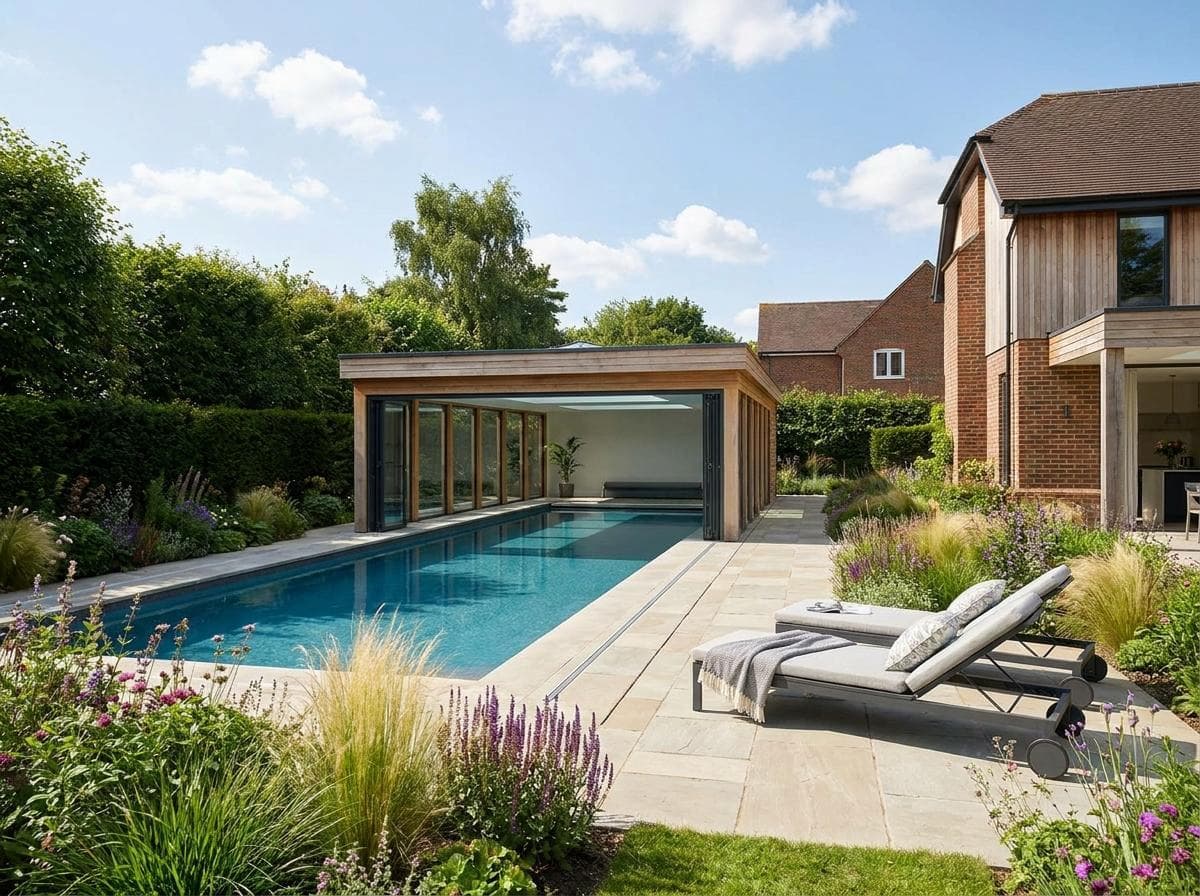
Indoor pools tend to hold their value better than outdoor pools, which can be a polarising feature for buyers
Before you pick a construction method, ask whether a pool fits your property and lifestyle.
Pools are luxury additions. They need ongoing maintenance, higher insurance premiums, and higher energy costs. Running a UK pool costs between 500 and 2,000 pounds per year for heating, plus 300 to 800 pounds for chemicals and water treatment.
What about property value? The answer isn’t straightforward. Some agents say a pool can add 10-20% to a house price. Others warn that it shrinks the buyer pool and makes the property harder to sell. Indoor pools hold value better because they’re usable year-round. Outdoor pools divide opinion, with buyers either loving the lifestyle or seeing a maintenance liability.
The “improve, don’t move” trend is real. Legal & General found in 2025 that 40% of Brits renovated their homes in the past year rather than relocate. If you’re committed to your current house, a pool can transform your outdoor space.
For homeowners already planning other upgrades, a pool fits naturally into a broader renovation plan. Check out our guide on modern renovation projects around the home to see how a pool coordinates with other work.
Understanding the Construction Process and Costs
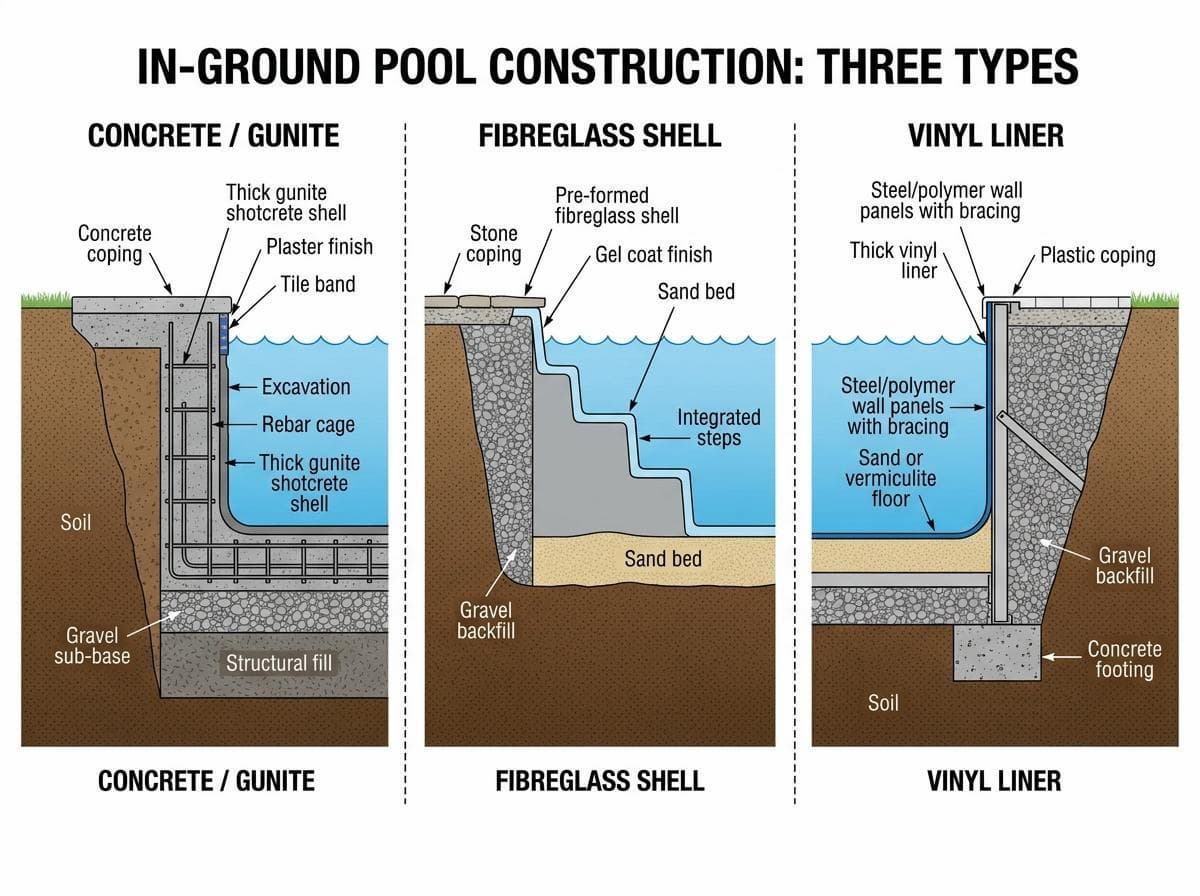
Different in-ground pool construction methods for UK gardens, from budget-friendly liner pools to premium concrete builds
UK pool construction falls into four main categories, each with a different cost profile and timeline.
- Concrete pools are the most customisable option. Builders spray gunite or shotcrete over steel reinforcement to create any shape, depth, or size. Construction takes 12 to 16 weeks and costs between 45,000 and 150,000 pounds. Concrete pools last for decades and can include features such as infinity edges, integrated spas, and bespoke tiling.
- Fibreglass pools arrive as a pre-formed shell that gets craned into a prepared hole. Installation takes four to eight weeks and costs 28,000 to 85,000 pounds. You sacrifice shape choice, but the gel-coat finish resists algae and needs fewer chemicals than concrete.
- Block liner pools use block walls with a PVC or rubber liner. This is the most budget-friendly option, priced between 22,000 and 55,000 pounds, with installation taking six to ten weeks. Liners need to be replaced every 8 to 12 years, costing around 3,000 to 5,000 pounds.
- Indoor pools represent the premium tier. You need a pool house or a substantial extension, which adds structural complexity: humidity control, ventilation, and dehumidification are mandatory. Costs start at 120,000 pounds and can exceed 250,000.
Whichever method you choose, work with a SPATA-registered installer. The Swimming Pool and Allied Trades Association sets UK quality standards for pool construction. Members must trade for at least three years and pass periodic inspections.
If you’re sequencing multiple renovations, think about the order. Our guide on renovating your house in the right order explains why a pool works best after structural work but before final landscaping.
Planning Permission and Regulations
Most outdoor pools are classified as permitted development under the Town and Country Planning Order 2015. You usually don’t need formal planning permission.
But exceptions apply. You’ll need permission if: – Your property sits in a conservation area, Area of Outstanding Natural Beauty, or World Heritage Site – The building is listed – You’re building an indoor pool with a pool house – The pool and existing outbuildings cover more than 50% of your garden – You live in a flat or maisonette
Check the Planning Portal for official guidance on whether your project needs permission. For indoor pools and pool houses, the National Planning Policy Framework, updated in December 2024, sets out how councils evaluate applications. Key considerations include visual impact, neighbour amenity, and flood risk.
If you need permission, the standard determination period is eight weeks. Approval rates for householder applications run at about 87%. You’ll submit drawings, a site plan, and a design statement.
Building regulations also apply. Pools need safety covers, proper drainage, electrical safety in wet environments, and structural compliance with approved documents. SPATA-registered installers handle building regs compliance as part of their service.
Choosing the Right Installer
A pool is only as good as the team that builds it. Cut corners during installation, and you get cracks, leaks, and expensive repairs.
SPATA membership is the clearest quality benchmark in UK pool construction. SPATA members undergo regular inspections and must demonstrate competence across design, construction, and aftercare. The association also offers a Stakeholder Account service that protects your payments during the build, with the installer paid in stages upon verification of work.
Get at least three quotes. A significantly cheaper quote should raise suspicion, not excitement. Each quote should break down costs for excavation, structural work, equipment (pump, filter, heater), tiling or finishing, and landscaping restoration.
Ask about warranties. Reputable installers offer 5- to 10-year structural warranties on concrete pools and 2- to 5-year warranties on equipment. Check public liability insurance too, as pool construction involves heavy machinery and deep excavation.
If you’re coordinating a broader garden redesign, building a pool offers an opportunity to rethink your whole outdoor space. Our article on upgrading your outdoor living space offers ideas for integrating a pool with patios, planting, and seating areas.
Conclusion
Building a swimming pool is one of the most significant projects a UK homeowner can take on. It involves multiple trades, substantial capital, and a long timeline. But with careful planning, it’s also one of the most rewarding additions you can make to your property.
Start with your finances. Compare secured loan options and understand the true cost before committing. Then work through planning permission, choose a construction method that fits your garden and budget, and vet installers thoroughly.
Treat it like the major construction job it is, not a summer whim. Plan carefully, budget realistically, and work with professionals who have the credentials to back up their promises.