Why Small Groundworks Demand a Digging Arm
Across British smallholdings and rural sites, the daily reality is a list of holes that must be dug. Footings for an extension, a land drain across a paddock, a trench for a water supply: these sit awkwardly between a spade and a hired excavator. For groundworkers on a tight budget, a backhoe attachment offers a third route, turning a tractor that sits idle most of the week into a digger for an afternoon with no day rate or hire period to absorb.
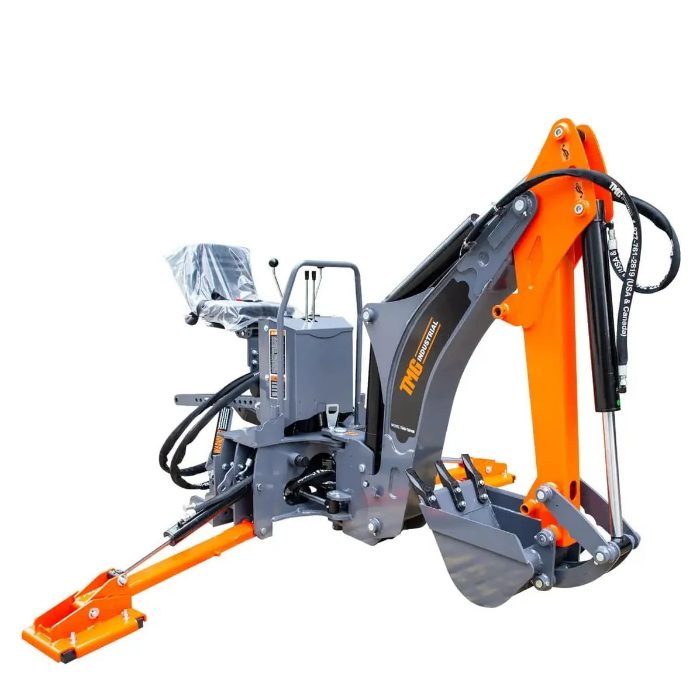
A Hydraulic Arm Built Like a Human Limb
The clearest way to picture the mechanism is to compare it with your own arm. The boom is the upper arm swinging from the shoulder, the dipper, or stick, is the forearm at the elbow, and the bucket is the hand curling at the wrist. The three jointed sections reach out, drop down and scoop back.
Each joint is driven by a hydraulic cylinder that extends or retracts to swing that section through its arc. Pressurised oil pushes a piston, and because that pressure acts across a large piston area, a modest pump produces a large force.
Reach comes from geometry rather than brute power: an eight-foot arm extends far enough to dig a usefully deep trench while the operator feathers each cylinder to follow the line of the cut.
How the Tool Mounts and Casts Its Spoil
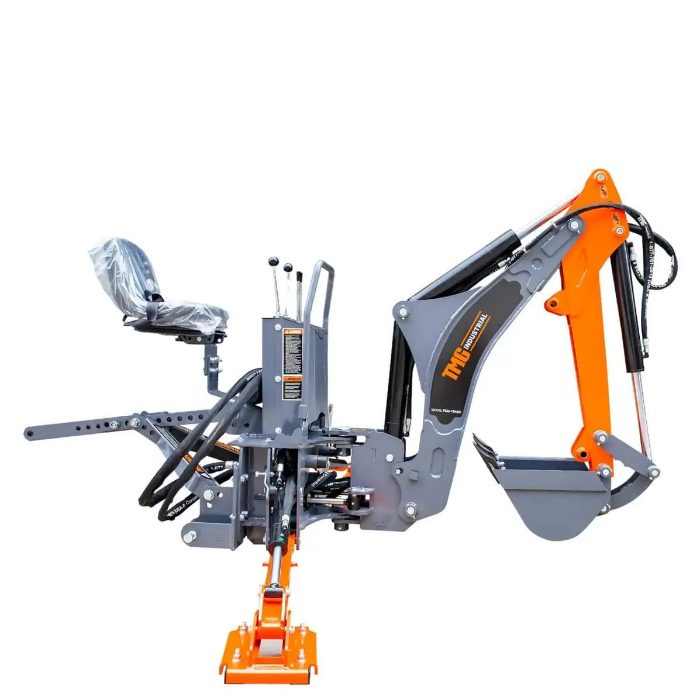
On a compact tractor the unit fastens to the three-point hitch, the standardised set of two lower lift arms and one upper link at the rear of almost every farm tractor. A Category 1 hook-up matches the pin sizes of smaller tractors, so the frame pins on quickly.
Once mounted, the whole arm can swing sideways through 180 degrees, which matters because spoil has to go somewhere: by swinging the boom to one side, the operator casts excavated material clear of the trench rather than back into it. A rotating twelve-inch bucket then dresses the cut.
Classifying Digging Arms by Carrier and Power Source
It helps to sort these tools two ways, the first being what carries them. A three-point-hitch backhoe attachment rides on a tractor; a skid-steer version clamps to a loader’s coupler; a dedicated excavator is a purpose-built machine.
•Tractor hydraulics: the arm draws oil from the tractor’s own pump, keeping the package light and inexpensive.
•Self-contained pump: a separate engine drives the hydraulics, freeing the design from the host but adding weight and cost.
The second division, how the cylinders are fed, sets the limits. Tractor hydraulics keep the backhoe attachment simple, though available flow caps cycle speed; a self-contained pump lifts that limit at the price of complexity, so it suits heavier, standalone equipment.
Weighing the Strengths and the Compromises
The honest trade-off is reach against convenience. A tractor-mounted backhoe attachment will never match the depth, swing speed or stability of a tracked excavator, and the operator must reposition more often.
Set against that, the gains are real: one machine covers ploughing, carting and digging, and scattered small jobs no longer justify a hire call-out. For the smallholder or jobbing groundworker, a backhoe attachment converts an idle tractor into a capable digger without a second engine to maintain.
A Yorkshire smallholder laying sixty metres of field drainage would otherwise face a two-day mini-excavator hire, but a digging arm on the existing tractor turns that into a weekend job done at the owner’s own pace.