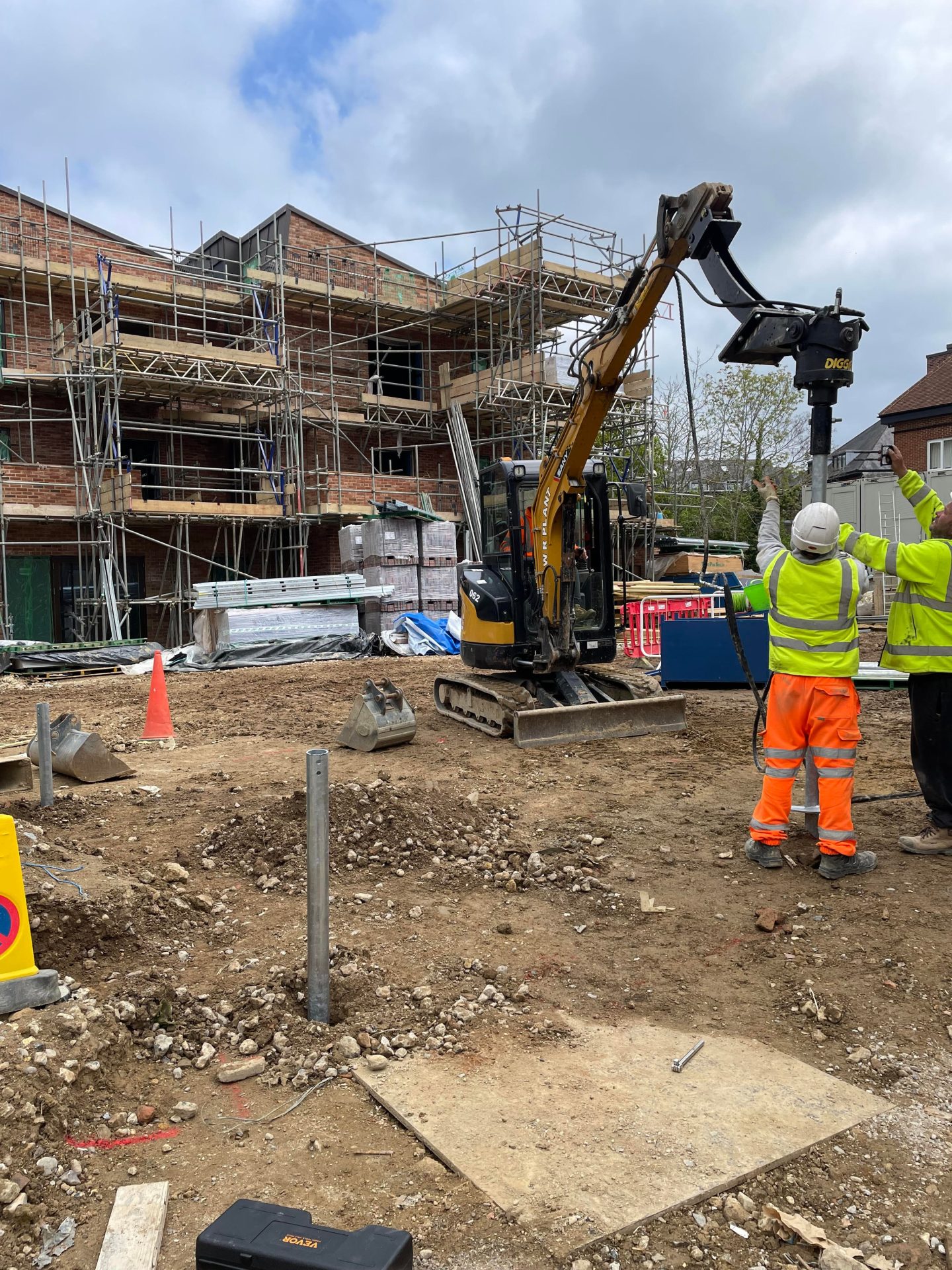
The piling rig arrived at 7am. By 10am, it was gone. It couldn’t fit through the access gate. Three weeks of programme time were lost before a single pile was installed.It’s a familiar story in London. The capital is full of constrained sites: Victorian terraces, basement extensions under occupied houses, and commercial fit-outs hemmed in on all sides. Traditional piling methods were never designed for these conditions. Yet they remain the default.Screw piles are faster, cleaner, and in many London scenarios cheaper. So why aren’t they being specified more often? Old habits. Engineers are still reaching for the methods they trained on, even when they’re not the right fit.
London’s Access Problem
Concrete foundations require a minimum of 3-4 metres of vehicle access. A conventional CFA rig needs overhead clearance of 10 metres or more when the mast is raised. Across much of inner London, neither exists. Contractors either source specialist low-headroom rigs at a significant premium or they lose time negotiating temporary access with neighbours.
Screw piles can be installed within restricted access sites through a gap as narrow as 800mm, roughly the width of a standard doorway. The equipment is a compact hydraulic motor head, usually mounted on a small tracked machine, and is hand-carried where needed. If you can walk through it, it can be piled through it.
Where the Real Savings Come From
Speed is the headline advantage. A complete screw pile installation on a typical London residential scheme takes two to three days, with instant structural capacity on completion. A full concrete foundation programme, including pour, cure, strip, and backfill, can run to a month. But the bigger savings come from what screw piles eliminate:
- No concrete trucks or pumps for the pile stage. The piles are load-bearing immediately on installation. A ground beam may still be required at the top, but the logistics of the pile stage itself are dramatically simpler.
- No arisings. CFA produces significant spoil volumes. Skip hire and disposal costs in London add up fast. Screw piles produce virtually nothing.
- No vibration. Installed by rotation, not impact. Critical in dense residential streets where neighbouring foundations may be shallow.
- No noise. A genuine programme risk under the Party Wall Act. Screw pile installation is quieter than most alternatives.
S. High-capacity screw piles can support loads up to 300 kN per pile, enough for traditional brick-and-block construction. A typical strip foundation for a two-storey house carries 20-50kN per linear metre, so 300kN per pile is substantial. The system suits everything from garden rooms to full house extensions.
On the right site, a screw pile programme that takes one day replaces one that would have taken five. That’s not a marginal improvement. It’s a revolution for your project’s budget and timeframe.
Do London’s Ground Conditions Stack Up?
Screw piles aren’t a universal solution, but London’s dominant geology suits them well. The typical inner London profile, Made Ground over London Clay, is conducive territory. London Clay is cohesive as well as consistent, offering good skin friction and end bearing for helical flights.
London’s expansive clay soils also create a specific problem for shallow foundations: seasonal moisture changes cause the clay to shrink and swell, generating movement that shallow concrete footings can’t reliably resist. Helical piles anchor below these unstable layers, providing durable stability that traditional strip foundations struggle to match in high-heave conditions.
The Made Ground layer is more variable, particularly on post-industrial east London sites where fill can include rubble or contaminated material. Hard obstructions during installation are a risk worth factoring into ground investigation. River gravels across the Thames flood plain present higher torque requirements but remain workable.
Screw piles also perform well in silty and unstable ground conditions where customary piling can struggle. The helical flight cuts into the soil rather than displacing it, which makes them especially effective where ground stability is poor. Where they’re less suited is heavily obstructed fill containing large rubble or hard inclusions, and very high-load applications needing several hundred kilonewtons per pile. For most London residential and light commercial work, neither of those is typically the issue.
Why They’re Still Underspecified
The most honest explanation is that old habits die hard. Engineers who trained in the 1990s and 2000s default to CFA or driven piling. Their software, their PI positions, and their subcontractor relationships all reinforce the habit. Specifying something less familiar requires additional justification, and most project schedules don’t reward that effort.
Main contractors with standing relationships with large piling companies have little commercial incentive to introduce a new subcontractor for a single package. And clients commissioning residential schemes rarely know enough to question whatever ends up in the tender documents.
The fix is simple: genuine consideration of screw piles at the feasibility stage, before the specification is locked in. On many London projects, that assessment would produce a different foundation choice.
One More Reason They Suit London Specifically
London has more listed buildings, conservation areas, and sensitive historic structures than almost any city in the UK. Historic England’s guidance on foundation works near existing fabric is sympathetic to low-impact installation methods. Screw piles, with their low vibration, low noise, and minimal ground disturbance, frequently satisfy that requirement where driven alternatives would not.
Tree Preservation Orders are another practical constraint that trips up conventional groundworks across London boroughs. Screw pile installation can be positioned to respect root protection zones, keeping projects compliant without the need to remove established trees or seek expensive TPO consents.
There’s also the matter of what gets left intact. Screw pile installation doesn’t require destroying paved areas, established gardens, or period architectural details to form a foundation. On properties where the finish matters, that’s a meaningful advantage.
Considering Screw Piles for your Next Construction Project?
Screw piles don’t suit every London project. But they suit far more of them than current specification rates reflect. On tight-access sites, constrained programmes, and structures adjacent to sensitive existing fabric, they offer a combination of speed, economy, and low disruption that conventional piling can’t match.
Screw pile foundations in London are a great fit: The ground conditions are right. The access advantages are real. The cost savings are there. The main obstacle is habit, and that’s fixable!