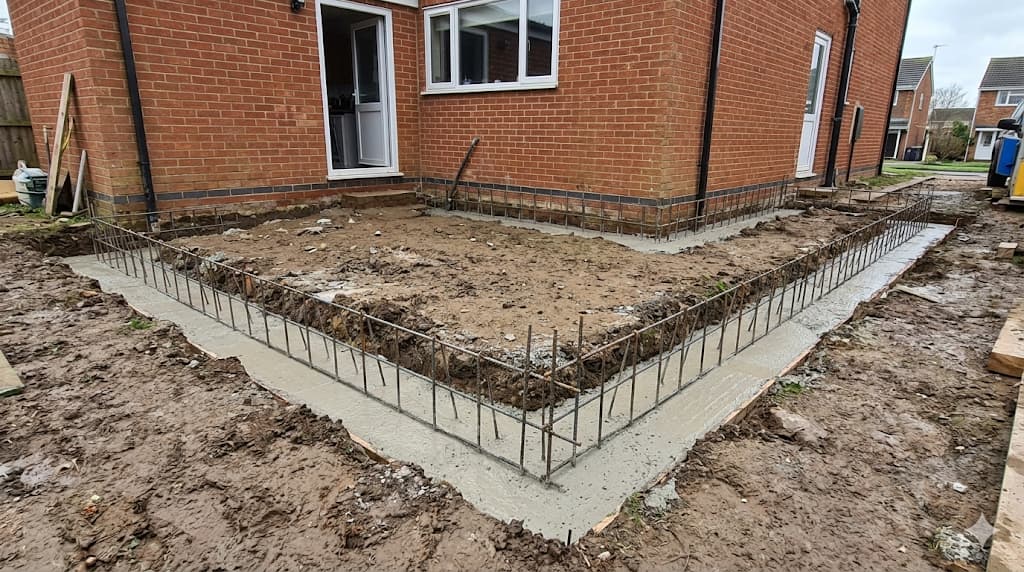
There is a particular kind of excitement that comes with planning a home extension. The kitchen is going to double in size, the living room will finally open onto the garden, and that cramped box room becomes a proper home office. Pinterest boards fill up, architects get commissioned, and conversations with the neighbours turn into gentle competitions about who has the best builder.
What almost nobody gets excited about is the bit that happens first — the foundations. They are invisible once finished, they have zero aesthetic appeal, and nobody has ever walked into a dinner party and said “you absolutely must see our strip footings.” And yet, without the right foundation, every other decision you make about your extension is built, quite literally, on unstable ground.
Foundations are where problems start when they go wrong and where they are prevented when they are done properly. Understanding why they matter and how they work is one of the most valuable things a homeowner can learn before breaking ground.
What Foundations Actually Do
At the most basic level, a foundation transfers the weight of a structure into the ground beneath it. The walls, roof, floors, and everything contained within them all exert downward force, and the foundation spreads that load across a sufficient area of soil to prevent the building from sinking, shifting, or cracking.
This sounds straightforward, and conceptually it is. The complexity lies in the fact that the ground beneath any given property is not uniform. Soil types vary enormously, even within a single plot. Clay behaves differently from sand, which behaves differently from chalk, which behaves differently from made ground — the term engineers use for land that has been previously filled or disturbed. Each soil type has a different bearing capacity, a different response to moisture, and a different seasonal behaviour.
A foundation that works perfectly on sandy gravel in Suffolk may fail catastrophically on shrinkable clay in Essex. This is why foundation design is an engineering decision, not a construction shortcut.
Why Extensions Present Unique Challenges
New-build foundations are designed as part of a complete structural package. Everything is calculated together — the loads, the soil conditions, the depth, the reinforcement — and the building goes up on a blank canvas. Extensions do not enjoy that luxury.
An extension must connect to an existing structure that may be decades old, built to different standards, and sitting on foundations that nobody alive has ever inspected. The new foundation needs to support its own loads while also accounting for the proximity of the existing building. Differential settlement — where the new structure settles at a different rate than the old one — is one of the most common causes of cracking at the junction between an extension and the original house.
Ground conditions around an existing property can also be complicated by mature trees, previous drainage routes, underground services, and years of landscaping that have altered the soil profile. What looks like a straightforward rear extension can, once the ground investigation is complete, reveal conditions that demand a more sophisticated approach than standard strip footings.
The Role of Ground Investigation
Before any foundation is designed, the ground needs to be understood. A ground investigation, sometimes called a site investigation or soil survey, involves taking samples from the proposed foundation location and testing them to determine the soil type, bearing capacity, water table level, and any contamination.
For smaller domestic projects, this might involve trial pits — hand-dug or machine-excavated holes that allow a visual and physical assessment of the ground. For larger or more complex schemes, boreholes may be drilled to greater depths to capture data from deeper strata.
The information gathered during this stage directly informs the foundation design. Skipping it is a false economy. Without accurate ground data, the structural engineer is essentially guessing, and guessing is not a word anyone wants associated with the thing holding their house up.
Types of Foundations Used in Domestic Extensions
The foundation specified for your extension will depend on ground conditions, the load of the proposed structure, proximity of trees and drains, and the access available for construction equipment.
Strip foundations are the most common type used in domestic construction. They consist of a continuous strip of concrete, typically 600mm wide and at least 450mm deep, running beneath all load-bearing walls. In straightforward ground conditions — firm clay or gravel at a reasonable depth — strip foundations are cost-effective and quick to construct.
Trench fill is a variation where the trench is filled entirely with concrete rather than partially. It is faster to pour, provides better resistance to ground movement, and is often preferred in areas with shrinkable clay soils where deeper foundations are required.
Pad foundations are isolated blocks of concrete used to support point loads, typically from steel columns. They are common in open-plan extensions where the internal space is free of load-bearing walls and the roof loads are carried by a steel frame.
Piled foundations represent the most robust solution and are used when the ground near the surface cannot adequately support the building. Piles are driven or bored deep into the earth until they reach a stratum with sufficient bearing capacity. A reinforced concrete ground beam then spans between pile heads, creating a platform on which the structure is built.
When Standard Foundations Are Not Enough
Several common scenarios push a project beyond the reach of conventional strip or trench fill foundations. Understanding these triggers helps homeowners anticipate the engineering requirements before they become unwelcome surprises.
The first is proximity to trees. In areas with shrinkable clay — which covers a large proportion of south-east England — tree roots can extract moisture from the soil, causing it to shrink in dry periods and swell when wet. This cycle of movement can crack conventional shallow foundations. The National House Building Council publishes detailed guidance on foundation depths relative to tree species and distance, and in many cases the required depth exceeds what strip foundations can practically achieve.
The second is poor or variable ground. Made ground, peat, soft alluvial deposits, and ground affected by historical mining activity may lack the bearing capacity to support strip foundations at any practical depth. In these conditions, the load must be transferred to a competent stratum deeper underground, which is precisely what piling achieves.
The third is restricted access. Urban and suburban sites frequently lack the space for large excavation equipment. Traditional deep strip or trench fill foundations require wide trenches and significant spoil removal, which is problematic when the only access is through a narrow side passage between two houses. This is where mini piling Essex and London has become an increasingly common solution. Mini piling rigs are compact enough to operate in spaces as narrow as one metre, making them ideal for rear extensions, basement underpinning, and sites where conventional plant simply cannot reach.
What the Piling Process Actually Involves
For homeowners unfamiliar with piling, the process can seem intimidating. In practice, a typical domestic piling job is surprisingly contained.
The piling contractor arrives with a specialist rig — either a driven or bored type depending on the ground conditions and the proximity of neighbouring structures. Driven piles are hammered or vibrated into the ground, while bored piles involve drilling a hole and filling it with reinforced concrete. Bored methods produce less vibration and noise, making them better suited to residential areas.
Each pile is installed to a predetermined depth specified by the structural engineer based on the ground investigation data. Once all piles are in place, the tops are trimmed level and a reinforced ground beam is cast between them. This beam acts as the foundation on which the walls of the extension are built.
The entire piling operation for a standard domestic extension typically takes between one and three days, depending on the number of piles required and ground conditions encountered. It is faster than digging deep conventional trenches in difficult ground and produces far less spoil.
Choosing the Right Foundation Contractor
Foundation work is not the place to cut costs. The consequences of a poorly designed or badly executed foundation can take years to manifest, but when they do — cracking, subsidence, structural movement — the remedial costs dwarf what was saved at the outset.
When selecting a contractor, look for proven experience in residential foundation work, relevant plant and equipment, and a willingness to work collaboratively with your structural engineer. Established piling and foundation contractors Essex and London clients across the south-east rely on will typically hold NHBC, LABC, or equivalent registrations and carry appropriate insurance for the scale of work involved.
Ask for case studies or references from projects similar to yours. A contractor who has successfully piled a two-storey rear extension on London clay will understand the specific challenges your project is likely to present. One who has only worked on commercial sites may not.
Building Control and Structural Sign-Off
All foundation work requires building control approval. Your local authority building control team or an approved inspector will need to inspect the foundations at key stages — typically after excavation and before concrete is poured. For piled foundations, the inspector will also review pile test results and the structural engineer’s design calculations.
It is the homeowner’s responsibility to ensure these inspections are arranged and that work does not proceed beyond an inspection stage without approval. Your contractor and structural engineer should manage this process as a matter of course, but it is worth confirming the arrangement at the outset.
The Foundation Sets the Ceiling for Everything Above It
It is tempting to view foundations as a necessary evil — an expensive, invisible phase that stands between you and the exciting part of the build. But every crack in a rendered wall, every door that sticks in its frame, every hairline fracture that appears six months after completion traces its origin back to what sits beneath the ground.
A well-designed, properly executed foundation does not just prevent problems. It creates the stable platform on which everything else performs as intended — the brickwork stays plumb, the lintels stay level, the floor stays flat, and the junction between old and new remains clean and crack-free for decades.
The foundation is not the boring bit. It is the bit that makes everything else possible.