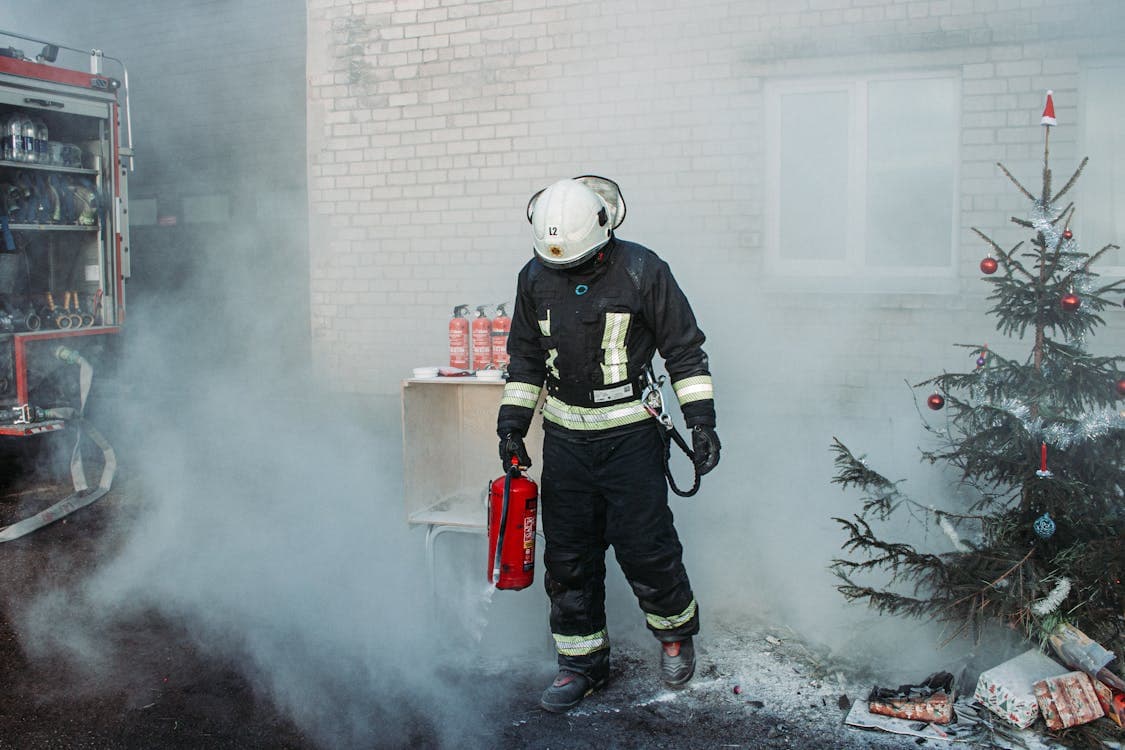
Any building can catch on fire and risk hundreds of lives. A single spark can turn into uncontrollable fire within a matter of minutes if fire safety is not taken into account while constructing a building.
Fortunately, after the Building Regulations Approved Document B updates and the incident of the Grenfell Tower fire, the fire safety measures are at the very center of every design decision in the UK. Especially for commercial buildings, there’s a much higher focus on how the materials really perform in day-to-day conditions and how all the different materials come together as a system to perform the best.
In this blog, we’ll discuss the commercial standard fire safety materials widely used in the UK.
Fire-Rated Cladding
Initially, the fire rated cladding for UK building projects was used for aesthetic purposes. However, now it has become an important part of how modern structures are designed to withstand the test of time under extreme and unexpected conditions. The claddings act as a first line of defence against external damage and, most importantly, from the fire by stopping its spread and protecting the actual building structure from getting damaged.
Sometimes, the cheap material catches fire quickly and accelerates its spread. On the flip side, a good, high-quality and certified fire-rated cladding is designed specifically to lessen the risk by:
- Resisting ignition
- Limiting flame spread
- Protecting structural integrity
- Standing up against extreme temperatures, even when kept up for long periods of time.
The best part about these claddings is that they come in many designs to fit with any kind of aesthetic you want. For example, the ThermoWood cladding for commercial buildings is widely used in the UK instead of real wood, not only because it looks aesthetic but also because it resists fire and keeps the building protected.
Fire-Rated Plasterboard
Fire-rated plasterboard doesn’t grab the limelight, but it quietly does a lot of heavy lifting backstage. Ceilings in office blocks, self-contained service enclosures within retail units, and partition walls of all kinds are typically found to have this kind of material incorporated. Ceilings and service enclosures in office blocks or retail units, hospitality spaces, and partition walls anywhere typically have this kind of material incorporated.
These boards include glass fibres or special additives which reinforce the material, helping it hold its form in case of intense fire. It safeguards the structural integrity and buys time for rescue teams to run their evacuation operations rather safely. It has become widely used throughout the UK for three simple reasons: it’s affordable, reliable, and just easy to install
Mineral Wool Insulation
For many public buildings and commercial enterprises, mineral wool is an indispensable material, especially if fire safety and thermal insulation are important requirements. Unlike the older types of insulation, mineral wool itself won’t burn, and it can withstand very high temperatures without melting. That makes it ideal for use in cavity barriers, partition walls and façade systems which prevent the spread of fire.
On top of that, it gives you better acoustics, which is a very important factor in offices, hotels, studios, and mixed-use developments where you need good noise control.
Intumescent Coatings
Steel frames and other structures are very common in commercial buildings, and although they don’t burn, they can quickly lose strength when they become too hot. Therefore, they need good protection, and that’s where intumescent coatings play their role. These paints react to heat by swelling into a thick, heat-insulating layer to cover the steel from all sides and prevent it from coming into contact with fire.
Intumescent coatings are a very clever solution for architects so they can pull off that exposed steelwork structural design that is high in demand in modern offices, without risking safety. It is widely used across the UK not only to maintain that appearance but also because it is efficient, visually unobtrusive and meets fire safety requirements.
Concrete and Masonry
Concrete and masonry are often not mentioned as much when you’re talking about fire safety, but they really are some of the most fire-resistant materials available. They are perfect for structural elements such as floors, cores, and partition walls. Therefore, reinforced concrete frames, in particular, are still widely used on UK commercial projects since they offer intrinsic fire protection without needing a lot of extras slapped onto them.
Blockwork is also frequently used in operation areas, service areas and machine rooms, etc., where fire separation plus strength are a high priority.
Fire-Resistant Glazing
Most modern commercial spaces now love to create an open plan that’s both airy and allows natural light through the structure. However, these plans can clash with fire compartmentation requirements since glass can easily break under high temperatures. Fire-resistant glazing solves this problem.
You can’t tell the difference, as far as appearance is concerned, between a glazing wall incorporating fire-resistant systems and an ordinary glass one. However, these fire-resistant glazing systems can withstand fire for a predetermined period of time (usually 30, 60, or 120 minutes). This type of glazing gives us a way to meet safety requirements without affecting the open atmosphere of the building
The Bottom Line
In this modern day, safety and appearance have become two equally important factors. The commercial construction industry cannot compromise on any of these vital demands. All the fire safety materials we have just discussed guarantee not only the safety of your building but also greatly enhance its appearance and ambience. Ultimately, the goal is to create spaces that are safe, look attractive, and are built to last.