Anyone who has handled a defects liability period knows the pattern. A building is handed over performing to specification, and within eighteen months the operational reality has drifted well away from the design intent.
Filters are loaded. Condensate lines are partially blocked. Terminal units are running at flow rates nobody has verified since commissioning. The BMS, where one exists, is reporting setpoints that bear little relationship to what the occupants are actually experiencing. None of this is a construction defect. It’s the absence of planned maintenance.
The gap between designed performance and operational performance has been documented repeatedly across the UK stock. The Building Performance Evaluation programme findings, and subsequent work through organisations such as CIBSE and the Usable Buildings Trust, have consistently found in-use energy consumption running well above design predictions. Maintenance regime is one of the recurring contributors.
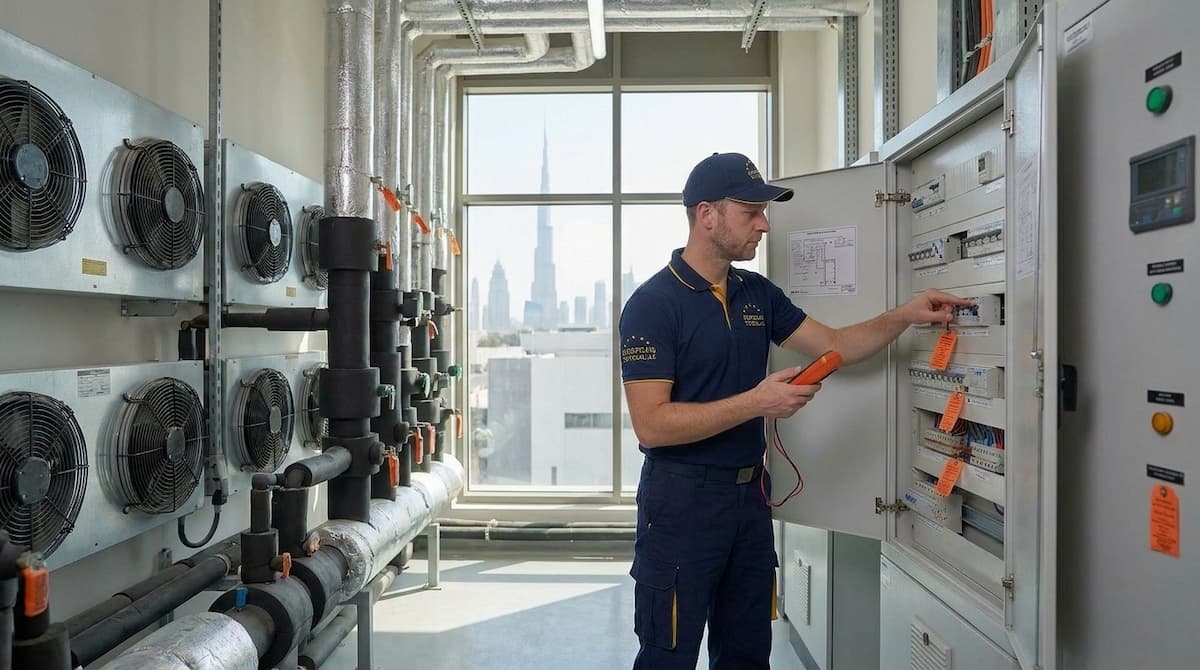
What Planned Preventive Maintenance Actually Delivers
The engineering argument for contracted maintenance rests on component degradation curves rather than on convenience.
Take a fan coil unit. A loaded filter increases pressure drop across the coil, which reduces airflow, which reduces heat transfer. The system compensates by running longer, which increases energy consumption and mechanical wear. Left long enough, reduced airflow across a cooling coil drives coil surface temperature down towards freezing conditions and you begin damaging the plant itself. The intervention is a filter change. Skipping it damages the compressor.
Refrigeration circuits follow a comparable logic. Condenser fouling raises condensing temperature, which raises compression ratio, which raises discharge temperature and current draw. Efficiency falls measurably. Chartered engineers working in refrigeration generally put the penalty from significant condenser fouling in the range of ten to thirty per cent on system efficiency, and the accelerated wear on the compressor is harder to quantify but entirely real.
Electrical distribution degrades differently but no less predictably. Thermal cycling loosens terminations. Loose terminations increase contact resistance. Resistance produces localised heating, which degrades insulation and eventually causes failure, sometimes catastrophically. Thermographic surveys and torque checks at planned intervals catch this while it’s still a maintenance item rather than an incident.
Water Systems and the Compliance Overlay
For UK practitioners, domestic water services carry a statutory dimension that residential maintenance in other jurisdictions often treats as optional.
Legionella risk assessment and control under ACOP L8 requires a written scheme, monitoring, and record keeping. Temperature checks at sentinel outlets, flushing of infrequently used outlets, cleaning and disinfection of calorifiers and cold water storage. This is not discretionary for duty holders, and in practice it’s the element most commonly found lacking when a compliance audit takes place on a residential block.
A properly scoped maintenance contract folds these tasks into the visit schedule and produces the records that demonstrate compliance. An informal arrangement with a local plumber does not.
The Gulf as a Stress Case
UK contractors and consultants working on Middle East projects encounter maintenance in a considerably harsher operating envelope, and it’s instructive.
Design ambient in the UAE sits above 45°C for extended periods. Cooling plant runs at near-continuous duty from April to October. Coastal humidity across much of Dubai’s residential development adds a latent load and a condensation management problem that UK schemes rarely face at that intensity. Airborne particulate from desert sand loads filters and fouls condenser coils at rates that make quarterly intervals reasonable where annual might suffice in a temperate climate.
The consequence is a compressed service life on plant. Equipment specified against European duty assumptions frequently reaches end of life in half the expected period without an intensive maintenance regime. It’s a useful illustration of what happens when the maintenance interval is wrong relative to the operating conditions, and the same principle applies at UK scale on a plantroom that’s simply been neglected.
Providers there have structured the residential offering accordingly. European Technical’s annual maintenance contracts for Dubai villas and apartments, as a market example, run from AED 1,499 per year for two air conditioning services plus annual plumbing and electrical inspection, through to AED 3,999 for quarterly whole-property inspection, four AC services with no unit cap, annual duct cleaning, included minor repairs, and a one-hour emergency response commitment. That top tier equates to roughly £850 a year, which is worth comparing against typical UK residential PPM pricing.
Contract Structure and What to Specify
For anyone drafting or procuring a maintenance agreement on residential or small commercial stock, the specification is where value is created or lost.
Define the asset register first. A contract priced without a surveyed schedule of plant is a contract priced on assumption, and the variations will follow. Serial numbers, locations, capacities, and installation dates for every item in scope.
Separate inspection from rectification explicitly. Contracts that promise minor repairs without defining a labour hours limit or a materials value ceiling invite dispute. State the threshold in numbers.
Specify measurement, not just attendance. A service visit should produce readings: supply and return air temperatures, refrigerant pressures, current draw against nameplate, water temperatures at sentinel outlets, insulation resistance where relevant. A tick-sheet without values is unauditable and tells you nothing about trend.
Set response times against a defined start point and attach a remedy. Attendance within four hours of notification is a commitment. Prompt attendance is not.
Establish the workmanship warranty period on rectification work and confirm it survives contract expiry. Twelve months is the normal expectation.
Records, Handover, and the Golden Thread
The Building Safety Act’s information requirements have made maintenance documentation a live concern rather than a filing exercise, at least for higher-risk buildings. The principle is worth applying more broadly.
A maintenance regime that produces dated, photographed, engineer-attributed records builds an asset history. That history informs lifecycle replacement planning, supports insurance positions, evidences statutory compliance, and transfers meaningfully at sale or on change of managing agent. A regime that produces cash receipts and verbal assurances produces none of that.
Digital reporting has become standard among competent providers for this reason. The value isn’t the app, it’s the searchable trend data across visits, which is what allows a facilities manager to see that a particular unit’s current draw has climbed twelve per cent over four services and act before it fails.
Commercial Reality
There’s a persistent view among smaller landlords and self-managing owners that planned maintenance is an expense to be minimised. The counter-argument is straightforward on lifecycle terms.
Reactive intervention costs more per event because it carries out-of-hours labour premiums, because failed components frequently damage adjacent components, and because emergency procurement removes any competitive tension from pricing. Add the consequential costs, void periods on residential lettings, business interruption on commercial, water damage remediation, and the case for planned intervention stops being marginal.
Plant life extension is the larger prize. Bringing a cooling plant to fifteen years instead of eight, on equipment with meaningful replacement cost and disruptive installation, dwarfs the cumulative maintenance spend that achieved it.
Practical Position
Contracted maintenance is not a sophisticated idea. It’s the recognition that building services are wearing mechanical and electrical systems operating continuously, and that scheduled intervention against a defined regime costs less over an asset’s life than intervention triggered by failure.
The industry knows this on commercial and institutional stock, where PPM has been standard practice for decades. The residential and small-landlord segment is slower to adopt it, and the performance gap in that stock reflects the difference.
Specify the asset register, define the scope in numbers, insist on measured readings, and keep the records. The rest follows.