Expanding your living space with a timber frame extension not only enhances aesthetic appeal but also maximizes functional usage. Grounded in structural integrity, the right foundation is crucial to ensure durability and safety. This comprehensive guide provides insights tailored to construction professionals and architects in the UK, focusing on selecting optimal foundation types for timber builds. Explore practical advice, product benefits, and strategies for cost-effective and robust groundwork solutions, ensuring your timber structure stands the test of time. Enhance your project’s success with expert-approved methods and innovative foundation technologies.
Brief Overview
Expanding living spaces with timber frame extensions adds both aesthetic and functional value. Selecting the right foundation is essential for ensuring the structure’s durability and safety. This guide offers UK architects and project managers detailed insights into optimal foundation types for timber builds, considering aspects such as soil conditions and environmental influences. By exploring options like strip and frame foundations, professionals can make informed, cost-effective decisions. The focus is on sustainability, using timber’s natural benefits to meet both structural and aesthetic goals, ultimately ensuring a robust, enduring construction.
Key Highlights
- Timber frames offer excellent thermal performance, reducing energy costs and aligning with sustainable construction practices.
- Choosing the right foundation system is crucial for the structural integrity and longevity of timber frame extensions.
- Strip foundations provide stability and cost efficiency, suitable for areas with different soil conditions.
- Frame foundations efficiently distribute loads, ideal for urban sites with constrained space.
- Customizing foundation design considers soil type and climate for the structural stability of timber builds.
Understanding the Basics of Timber Frame Construction
Timber frame construction offers a versatile and sustainable method for building extensions, providing several benefits that are critical to the success of a project. Its flexibility and aesthetic appeal make it a popular choice for both residential and commercial developments, especially in the UK. Selecting the right foundation system is essential for ensuring the structural integrity and longevity of your timber frame extension. This section explores the advantages of timber frame for extensions and highlights key considerations when embarking on timber frame projects, offering insights and practical tips to construction project managers and architects.
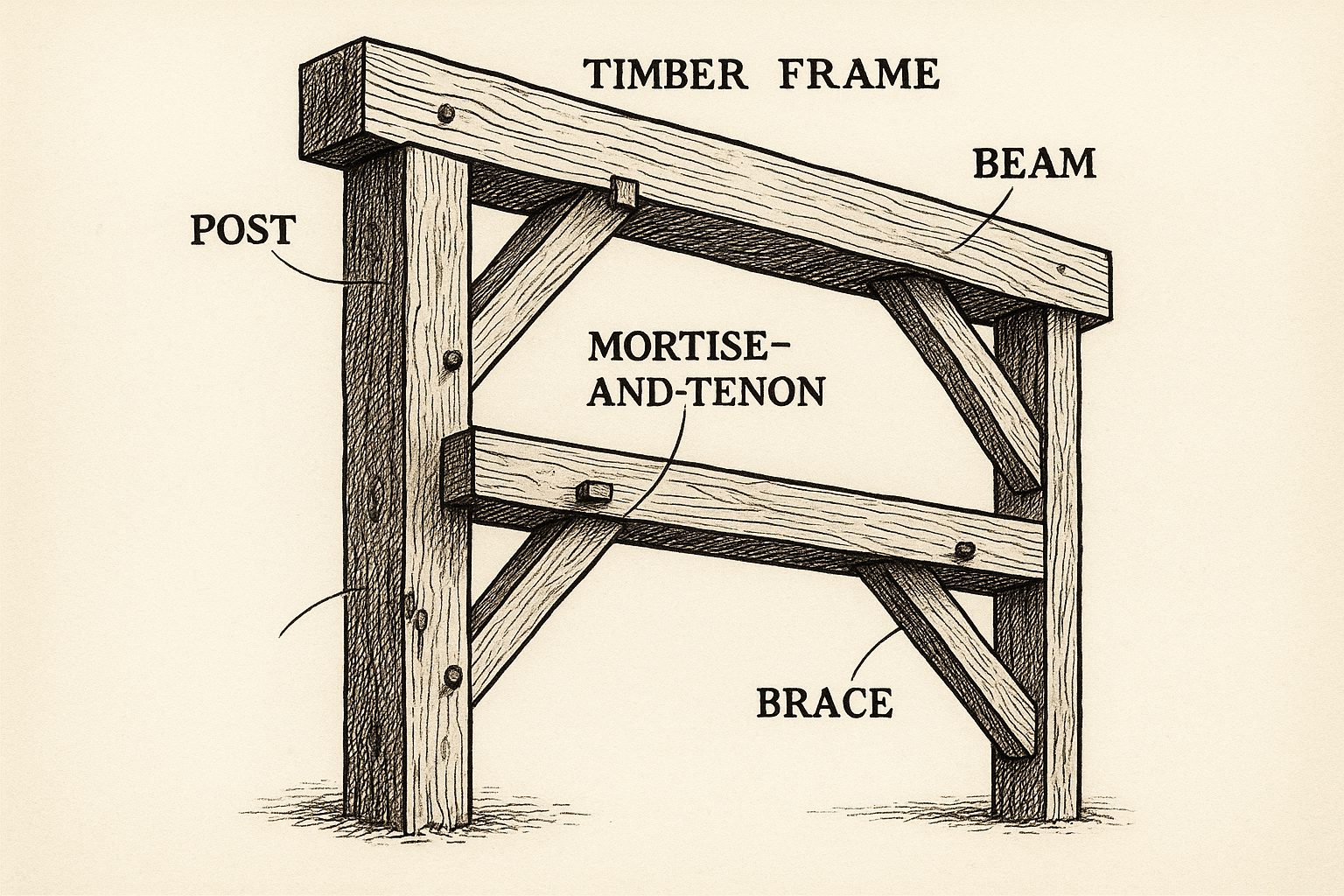
The Advantages of Timber Frame for Extensions
Timber frame extensions are ideal for those seeking an efficient and eco-friendly construction method. This type of extension offers excellent thermal performance, reducing energy consumption and lowering heating costs. The natural insulating properties of timber contribute significantly to the overall energy efficiency of the building, which aligns well with sustainable construction practices. Because timber is a lightweight material, it requires a less complex and often less expensive foundation system compared to more traditional building materials. The adaptability of timber also allows for creative designs that blend seamlessly with existing structures, enhancing aesthetic appeal without compromising structural integrity.
Moreover, timber frames are exceptionally quick to assemble, which can significantly reduce the overall construction timeline. This aspect of timber frame construction can lead to cost savings on labour and project management. The prefabrication of timber components enables precise measurements and cuts, ensuring a more accurate construction process and reducing waste. When choosing a foundation for a timber frame extension, it’s vital to consider the load-bearing capacity required, whether you’re working with garden rooms or full residential houses.
The reduced weight of timber makes it easier to adapt the foundation type according to site specifics, such as soil conditions and existing support structures. This flexibility can be particularly advantageous in urban environments where space and access are limited. These advantages collectively contribute to a robust, sustainable, and aesthetically pleasing extension that complements the existing architecture, providing durability that stands the test of time. For construction project managers and architects, making informed decisions on foundation design is crucial to leveraging these benefits effectively. Enjoy the process of crafting beautiful and resilient structures with timber, an age-old yet innovative building material.
| Benefits | Considerations | Strategies |
| Energy-efficient insulation properties | Requires detailed planning and precision | Utilize advanced design software for planning |
| Quick assembly and reduced construction time | Susceptible to moisture-related issues | Implement moisture control measures |
| Lightweight structure, reducing foundation requirements | Requires regular maintenance and inspection | Schedule routine maintenance checks |
| Adaptable for future modifications and extensions | Costs can be higher for specialized designs | Consider long-term savings on energy costs |
This table summarizes the critical aspects of timber frame construction, illustrating the balance of advantages, considerations, and strategies necessary for successful project outcomes.
Key Considerations in Timber Frame Projects
When planning a timber frame extension, it’s crucial to account for specific factors that can affect the success of the project. First and foremost, understanding the impact of the local climate on timber is essential. Timber is a natural material and can react to varying humidity and temperature levels, which might influence both the choice of timber and the foundation system. Partnering with local suppliers who are knowledgeable about regional climate conditions can ensure suitable material selection, promoting longevity and performance.
Additionally, the choice of foundation design plays a pivotal role in the project’s outcome. Considerations such as soil type, load distribution, and potential building regulations are key factors affecting foundation choice. It’s important to engage with structural engineers early in the planning stages to identify the best foundation type for your specific site. A well-designed foundation ensures that the timber frame structure will remain stable and robust, withstanding various environmental challenges.
Project managers should also consider the potential for future expansions. Timber frames offer flexibility not just in design but also in adaptation, allowing for easy modifications or extensions in the future. Scalable foundation systems can be an investment for future-proofing the timber frame extension. Moreover, integrating sustainable practices in both design and construction can enhance the extension’s value, benefiting not just the immediate environment but also aligning with broader environmental strategies.
Careful planning, combined with the knowledge of the site’s specifics and a commitment to sustainable building practices, can greatly enhance the success of timber frame projects. This approach ensures a balance between creativity, functionality, and the natural beauty of timber. Construction professionals and architects should continuously seek to innovate while respecting the traditional techniques that have proved reliable over centuries. By doing so, they can create enduring structures that reflect both modern needs and timeless appeal.
| Benefit | Key Considerations | Foundation Insights | Environmental Impact |
| Quick assembly time, reducing onsite labor costs | Requires precision to ensure structural integrity | Strong connection points are critical for stability | Renewable resource with a lower carbon footprint |
| Design flexibility allowing for creative architectural solutions | Susceptible to moisture if not properly treated | Suitable for various terrains with adaptable foundation types | Sustainably sourced timber contributes to eco-friendly buildings |
| Excellent thermal performance for energy efficiency | Fireproofing treatments may be necessary | Foundation must support load without excessive settling | Energy-efficient materials lower greenhouse gas emissions |
This table encapsulates the efficiency and adaptability of timber frame construction, serving as a quick reference for architects and project managers seeking sustainable building solutions.
Types of Foundations for Timber Buildings
Choosing the ideal foundation for your timber frame extension is a crucial step in the construction process, impacting the overall stability and longevity of the structure. Different foundation types offer various benefits based on soil, climate conditions, and structural demands. Let’s explore popular foundation systems suitable for timber constructions, such as frame foundations and strip foundations, focusing on their functional advantages and why they are preferred by construction professionals. These insights will guide architects and project managers in making informed decisions that align with specific project needs and site contexts, ensuring durability and efficiency.
| Foundation Type | Key Advantages | Considerations | Suitable Soil Conditions | Construction Settings |
| Frame Foundations | Flexible design and installation; Economical for lighter structures | May require additional engineering for heavy loads | Stable soils with low to moderate moisture content | Ideal for sites with minimal ground movement |
| Strip Foundations | Provides a continuous support, distributing loads evenly | Can be costlier and more labor-intensive; Not suitable for low-bearing capacity soils | Firm, dry, and stable soils to prevent settling | Best for uniform, level ground and single-level structures |
This table provides an at-a-glance comparison of foundation types, aiding construction professionals in selecting the most appropriate foundation system for timber buildings.
Popular Frame Foundations for Timber Structures
Frame foundations are essential for supporting lightweight structures, making them ideal for timber buildings where flexibility and adaptability are paramount. One of the key advantages of frame foundations is their ability to distribute loads efficiently across varying soil conditions, ensuring stability even on challenging grounds. These foundations often involve a concrete slab, a popular choice due to its strength and durability. By utilizing a concrete slab, you create a uniform support system that adequately distributes the weight of the timber frame, reducing the potential for excessive settlement or structural cracks. In many cases, prefabricated components make the installation of frame foundations more efficient, leading to time and cost savings during construction.
Incorporating the right foundation system involves understanding the soil type and the depth of the required foundation. Soil testing is crucial at the outset to anticipate potential shifting or settling that could affect the structural integrity. Project managers often work closely with geotechnical consultants to select the proper foundation depth, balancing the need for stability with cost considerations. By assessing these variables, professionals can choose a foundation type that maximizes longevity, a significant advantage when planning for future expansions or modifications to the timber frame extension.
For construction projects in urban settings or on constrained sites, pile foundations can offer a valuable alternative. They allow builders to bypass upper layers of poor soil, reaching stronger strata below, providing effective support for timber structures. This type of foundation system complements the modular nature of timber construction by enabling quick, precise installation, minimizing disturbances to the existing landscape. By selecting frame foundations carefully, you ensure that your timber buildings are built on a solid foundation, aligning with sustainable construction goals while maintaining efficiency and aesthetic integrity.
| Foundation Type | Key Benefits | Soil & Site Suitability | Construction Considerations |
| Frame Foundations | Lightweight, Cost-effective, Quick Installation | Ideal for stable, well-draining soils; suitable for sloped sites | Requires precise alignment; may need additional bracing |
| Strip Foundations | Strong load-bearing capacity, Durable | Suitable for varying soil conditions, including clay | Time-consuming; requires more materials and excavation |
This table provides a comprehensive overview of key foundation options for timber structures, aiding construction professionals in making informed decisions.
The Role of Strip Foundations in Timber Frame Extensions
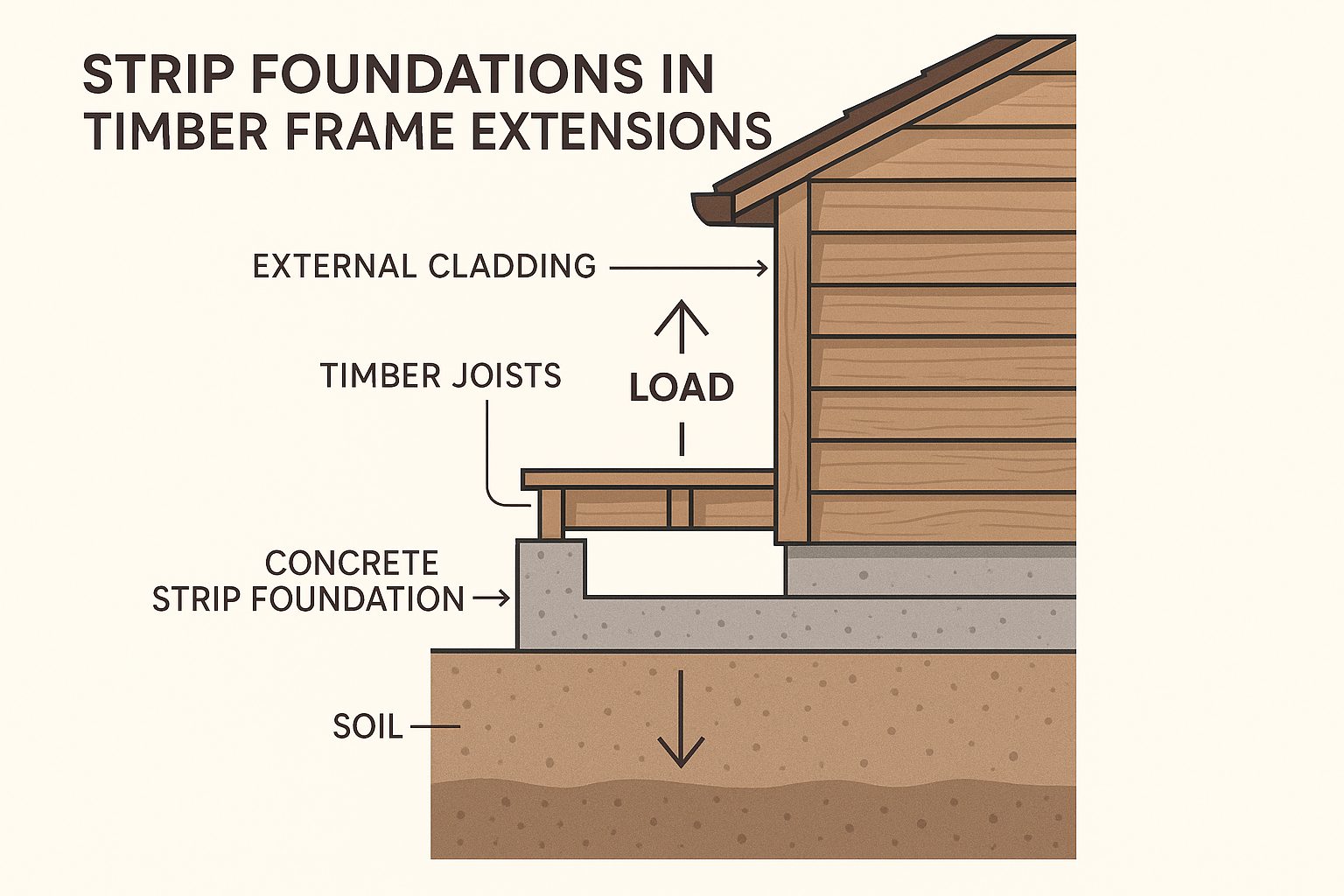
Strip foundations are widely employed in timber frame extensions due to their simplicity and cost-effectiveness. Typically constructed using a continuous strip of concrete, these foundations run under load-bearing walls, distributing the weight evenly and providing a solid base for lightweight timber structures. The benefit of strip foundations lies in their versatility; they can be adapted to different soil conditions with relative ease, even in areas where the ground may not naturally support a heavier building load. This adaptability makes strip foundations particularly suitable for timber frame extensions that demand both stability and cost efficiency.
To design effective strip foundations, determining the correct depth is critical. The foundation depth must be sufficient to reach firm soil, preventing the building from shifting or settling over time. Additionally, integrating a trench fill technique can enhance foundation strength by using concrete to fill trenches to a higher level, reducing excavation needs and making it an environmentally friendly option by minimizing soil disruption. This enhances the structural integrity of timber frame extensions while keeping costs manageable.
Moreover, strip foundations provide an excellent base for residential timber extensions where speed of construction is essential. Their straightforward design allows for faster implementation, aligning perfectly with the rapid assembly capabilities of timber frames. Choosing strip foundations offers construction managers and architects a robust, reliable option that integrates seamlessly with timber frame construction practices. By emphasizing efficient load distribution and adapting to diverse ground conditions, strip foundations play a pivotal role in ensuring the success of timber frame projects, providing the necessary support while facilitating creative and sustainable architectural solutions.
| Foundation Type | Key Advantages | Ideal Conditions | Implementation Considerations |
| Piers | Cost-effective and minimizes ground disturbance | Sloped or uneven terrain | Requires precise alignment and spacing |
| Slab-on-grade | Strong and durable; supports heavy loads | Flat, stable soil conditions | Needs proper site preparation and drainage |
| Crawl Space | Offers easy access to utilities | Areas prone to moisture and flooding | Must ensure adequate ventilation and pest control |
| Basement | Provides additional usable space | High cost, provides excellent insulation | Requires reinforcement against water infiltration |
This table provides a concise overview of the foundation options for timber buildings, emphasizing their strengths and situational applicability for construction projects.
Customizing Foundation Design for Timber Frame Extensions
When planning timber frame extensions, customizing the foundation design is crucial to align with specific project needs and environmental conditions. Construction professionals must consider factors like soil type, load distribution, and site specifics to ensure structural stability. Proper adaptation of foundation design enhances the longevity and safety of timber buildings. Exploring factors influencing foundation type and adapting designs to suit timber specifics will empower construction project managers and architects in their decision-making. These tailored approaches ensure your timber frame extension not only meets aesthetic goals but also complies with structural integrity requirements.
| Factor | Consideration | Optimal Foundation Types | Environmental Impact |
| Soil Type | Assess stability and drainage | Strip Foundations, Raft Foundations | Minimal disruption with proper design |
| Structural Demands | Load-bearing capacity | Pile Foundations, Pad Foundations | Efficient use of materials reduces footprint |
| Regulatory Compliance | Adherence to local building codes | Varies by jurisdiction | Compliance ensures sustainable practices |
This table underscores the importance of tailoring foundation designs to the unique requirements of timber frame extensions, contributing to their structural integrity and environmental sustainability.
Factors Influencing Foundation Design
The foundation design for a timber frame extension is influenced by several critical factors, each contributing to the overall stability and safety of the structure. One of the foremost considerations is the ground conditions, including the soil type and depth. Soil testing is vital to understand its bearing capacity and characteristics. This ensures that the foundation system chosen can adequately support the timber frame without excessive settlement or structural issues. Poor soil conditions might lead some designs, such as trench fill foundations, to be more suitable due to their ability to distribute loads evenly over a wider area, thus providing a stable base even on challenging soils.
Another influential factor is the structural demands of the timber frame itself. Timber, being a lightweight material, typically requires different foundation types compared to heavier materials like concrete or steel. For many timber extensions, strip foundations or frame foundations may be sufficient, as they align well with the load distribution requirements of timber structures. The climate of the site can also affect foundation choice; areas with high rainfall or frequent frost might require deeper foundations to prevent movement caused by ground moisture fluctuations. Moreover, architects must consider potential environmental impacts and seek solutions that minimize ecological footprints while ensuring structural durability.
A detailed understanding of building regulations is essential when designing foundations for timber frame extensions. This includes compliance with local construction standards and ensuring that the chosen foundation system meets all safety and environmental requirements. Engaging structural engineers early in the project can provide valuable insights into the best foundation type, ensuring all factors are effectively addressed. Ultimately, customizing the foundation design for your timber frame project requires a balance of technical knowledge, environmental considerations, and aesthetic objectives, offering a robust and resilient solution for your construction needs.
Adapting Designs to Suit Timber and Site Specifics
Adapting foundation designs to suit both timber and site specifics is a dynamic process that significantly impacts the success of a timber frame extension. Timber’s inherent adaptability means that the foundation system must be versatile enough to align with the extension’s unique requirements. A foundation type that considers the specific properties of the timber used and its interaction with the soil and environmental conditions can enhance the structural integrity and longevity of the building.
Key to this adaptation is understanding the site’s specifics, such as topography, existing structures, and access constraints. For example, in urban areas where space is at a premium, a foundation system that minimizes site disturbance while offering robust support is crucial. Pile foundations may be appropriate in such contexts, as they bypass upper soil layers and anchor into deeper, more stable strata. This strategy not only provides a sound base for the timber extension but also aligns with sustainable construction practices by reducing the environmental impact.
The timber itself plays a pivotal role in dictating the foundation design. Since timber has excellent load distribution properties, it may not require deep foundations, as heavier materials often do. Instead, foundations can be optimized for timber’s lightweight nature, using strip foundations or trench fill foundations, which are both cost-effective and efficient to implement. This adaptability allows architects to create extensions that complement existing structures seamlessly while adhering to both budgetary constraints and aesthetic aspirations.
Innovative design approaches, such as integrating modular construction techniques, can further enhance the adaptability of foundation systems to suit timber. By prefabricating certain elements, the construction process for timber frame extensions becomes faster and more precise, reducing waste and improving performance. Engaging in a collaborative design process with structural engineers and site managers ensures that all potential challenges are addressed early, resulting in a foundation that not only supports the timber extension effectively but also respects the project’s environmental, structural, and visual goals. Empowering architecture professionals to adopt these adaptive strategies fosters creativity, sustainability, and resilience in timber frame construction.
Ensuring Durability and Stability in Timber Frame Projects
For construction professionals, the goal of creating timber frame extension projects that last starts with ensuring durability and stability. This involves selecting the right foundation type, understanding the particular needs of timber materials, and considering long-term project factors, including future expansions. The robustness and performance of your extension depend greatly on the foundation system employed. Several strategies can be beneficial, from choosing the appropriate ground depth to evaluating structural needs, to laying foundations that stabilize the frame. These decisions are crucial for optimizing the performance and support of your structures.
| Foundation Type | Durability Factors | Environmental Considerations | Future-Proofing Strategies |
| Concrete Piers | Moisture Resistance | Minimal Land Disturbance | Adaptable Design |
| Slab-on-Grade | Pest Control Measures | Local Material Sourcing | Energy Efficiency Enhancements |
| Basement Foundation | Quality Timber Treatments | Climate Impact Assessment | Flexible Space Usage |
| Post and Beam | Structural Engineering Integrity | Eco-friendly Finishes | Technology Integration |
This table encapsulates the comprehensive strategies for enhancing the durability and stability of timber frame extensions, highlighting the synergy between foundational choices and future-proofing considerations.
Long-Term Strategy for Timber Frame Extensions
Developing a long-term strategy for timber frame extensions starts with a thorough understanding of foundation type and its integral role in ensuring durability and stability. Construction professionals must weigh various factors before laying foundations, such as soil conditions, climate impact, and intended building usage. By taking these into account, one can craft a foundation system that offers robust support for the intended frame extension while maximizing its structural integrity over time.
A well-planned foundation design not only improves the performance of a timber frame extension but also aligns with sustainable construction practices. Choosing foundations timber that minimize environmental disruption while supporting lightweight structures exemplifies this balance. The versatility of timber’s load-bearing capability often means that less invasive foundations, such as strip foundations, can be employed. These foundations fit well where ground conditions permit, ensuring that the weight of the frame is evenly distributed, reducing strain, and preventing deformation over time.
When planning for the long-term, it’s essential to consider potential expansions or modifications. Timber’s adaptability makes it an excellent candidate for future-proofing. Investing in a foundation system with scalability in mind ensures the extension remains viable for years to come. By prioritizing depth and support, construction managers can leverage these extensibility options easily, adapting the building’s footprint without compromising its foundational integrity.
To optimize the durability and longevity of your timber project, collaboration with structural engineers can provide insights into appropriate foundation depths and design. Incorporating ground assessments and the latest in engineering techniques, such as 3D ground mapping and geothermal testing, can anticipate future shifts in performance requirements. This proactive approach not only boosts stability but also embraces a forward-thinking perspective, ensuring your timber frame extension remains a benchmark for excellence, stability, and architectural creativity.
List of Considerations for Maximizing Foundations of Timber Frame Extensions
- Comprehensive soil analysis to optimize foundation type and ensure stability.
- Implement climate-specific adaptations for resilience and minimized environmental impact.
- Select foundation options that enhance timber’s load-bearing strengths.
- Utilize advanced engineering techniques, such as 3D mapping, for precise planning.
- Incorporate eco-friendly materials to boost sustainability and reduce carbon footprint.
- Develop future-proofing strategies to enable expansion without structural compromise.
- Facilitate ongoing collaboration with structural engineers for design validation and adjustments.
Through these measures, construction teams can significantly improve the durability and flexibility of timber frame extensions.
In conclusion, selecting the right foundation for a timber frame extension is crucial to ensuring the longevity and safety of your structure. By understanding the various options available, such as concrete slabs, screw piles, or strip foundations, and evaluating them against your specific site conditions, you can make an informed decision that supports both your building’s integrity and budget. For further guidance, consult with experienced professionals who can tailor solutions to your project’s unique needs. Remember, investing time in choosing the right foundation today protects your timber frame investment for years to come.
FAQs
What are the benefits of using timber frame extensions?
Timber frame extensions offer several advantages, including excellent thermal performance, reducing energy consumption, eco-friendliness, and quick assembly. This makes them ideal for both residential and commercial developments, particularly aligning with sustainable construction practices.
Why is selecting the right foundation crucial for timber frame extensions?
Choosing the right foundation is essential to ensure the structural integrity and longevity of timber frame extensions. The foundation must support the lightweight structure, consider soil type, climate conditions, and future modifications to maintain stability over time.
How do strip foundations benefit timber frame extensions?
Strip foundations are cost-effective and offer stability by distributing the weight evenly across continuous concrete strips under load-bearing walls. This method is versatile and adapts well to different soil conditions, providing a solid base for lightweight timber structures.
What role do climate conditions play in foundation design for timber extensions?
Climate conditions significantly impact foundation design due to timber’s natural susceptibility to humidity and temperature changes. Considering these factors ensures the foundation system accommodates potential expansions, supports load distribution, and maintains structural integrity over time.
What factors influence the choice of foundation for timber construction in urban environments?
In urban environments, limited space and soil conditions necessitate foundation systems like pile foundations, which provide support by reaching stable soil strata beneath upper layers. This approach minimizes site disturbance and maintains the aesthetic and structural integrity of timber extensions.